



e19732026-10-11T21:04:00+03:00
Air-Cooled Chiller Selection and Installation
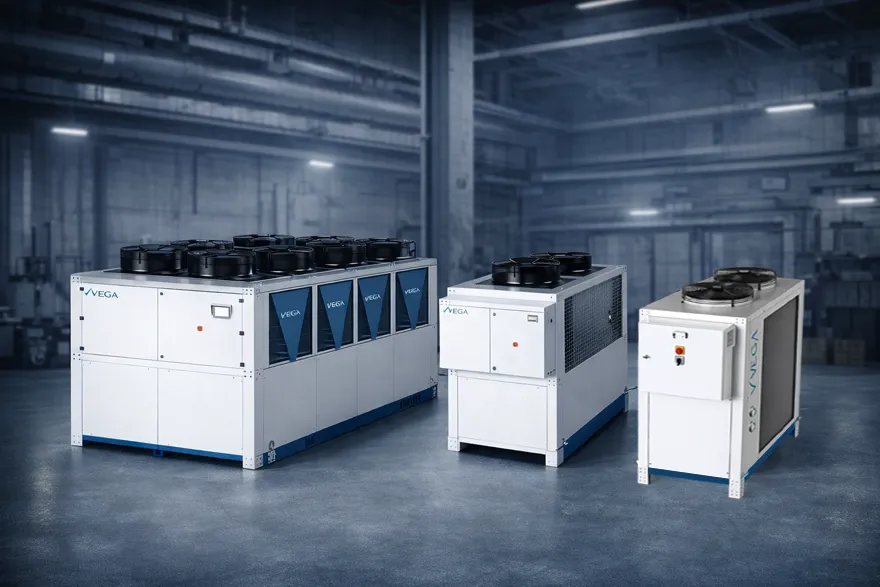
An air-cooled chiller rejects condenser heat to outdoor air using fans. It avoids a cooling-tower circuit, but still requires a correctly designed process-water circuit and sufficient airflow around the unit.
Location and airflow
Hot discharge air must not recirculate to the condenser inlet. Walls, roofs, neighbouring units and wind effects must be considered. Service access and airflow clearance are separate requirements, both determined from the manufacturer installation drawing.
Capacity in summer conditions
Higher outdoor temperature changes condenser operating conditions. Compare cooling duty and electrical input at the specified leaving-water and design ambient temperatures. A constant cooling capacity at every outdoor temperature must not be assumed.
Vega series options
VG SS and VG DS can be screened for smaller duties, while VG MS and VG DW serve larger nominal ranges. A series name does not confirm that a pump is included in every model. Check the technical table and the quotation scope.
Project inputs and calculation boundaries
For a quotation, specify approximate heat duty, fluid, inlet and outlet temperatures, flow, pressure loss and operating hours. Design ambient conditions, indoor or outdoor location and electrical infrastructure are also selection inputs. Flow and temperature readings must represent the same operating point. Do not transfer a catalogue capacity directly to different temperatures; confirm model performance at the required duty.
Commissioning and operating records
Check circuit cleanliness, filtration, air removal, proven flow and sensor readings. Record reference water temperatures and load conditions during commissioning. These values provide a baseline for maintenance and alarm investigations. Confirm pumps, tanks, connections and control options against the agreed quotation scope.
Frequently asked questions
Is the series capacity range sufficient for final selection?
No. Confirm the actual model at the required fluid temperature, ambient conditions, fluid properties and hydraulic duty.
Is cooling capacity the electrical consumption?
No. Cooling kW and electrical-input kW are different quantities. An energy assessment also needs actual load and operating hours.
What information is needed for a quotation?
Provide the industry or equipment, target temperature, approximate duty, flow, ambient conditions, operating hours and details of the existing system.
These explanations provide general engineering guidance. Examples are not field measurements or performance guarantees for a particular model.