



e19732026-10-11T21:04:00+03:00
What Is a Chiller? Industrial Cooling Systems
A chiller removes heat from a process through water or a suitable heat-transfer fluid. In a vapour-compression unit, the evaporator cools the process fluid and the condenser rejects both the process heat and the compressor energy input.
Two separate fluid circuits
Process water or a water-glycol mixture circulates between the equipment and the evaporator. Refrigerant travels around a separate closed circuit containing the compressor, condenser, expansion device and evaporator. Air-cooled and water-cooled describe the condenser side, rather than the presence of water in the process circuit.
Where chillers are used
Plastic moulds, chemical reactors, printing lines, food processes and equipment cooling each require different temperatures and flow rates. Two chillers with the same nominal capacity may differ in temperature stability, available pump head, fluid compatibility and redundancy.
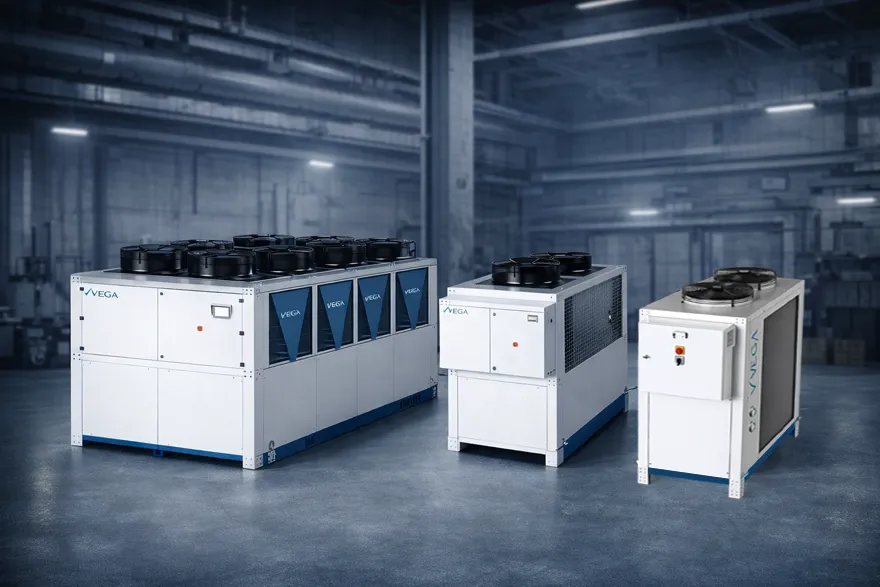
Selecting from the Vega range
The VG SS, VG DS, VG MS and VG DW product pages contain existing technical tables. Series ranges support initial screening; the final model must be selected at the required leaving-fluid temperature, ambient conditions and operating load. Cooling capacity is different from electrical input.
Project inputs and calculation boundaries
For a quotation, specify approximate heat duty, fluid, inlet and outlet temperatures, flow, pressure loss and operating hours. Design ambient conditions, indoor or outdoor location and electrical infrastructure are also selection inputs. Flow and temperature readings must represent the same operating point. Do not transfer a catalogue capacity directly to different temperatures; confirm model performance at the required duty.
Commissioning and operating records
Check circuit cleanliness, filtration, air removal, proven flow and sensor readings. Record reference water temperatures and load conditions during commissioning. These values provide a baseline for maintenance and alarm investigations. Confirm pumps, tanks, connections and control options against the agreed quotation scope.
Frequently asked questions
Is the series capacity range sufficient for final selection?
No. Confirm the actual model at the required fluid temperature, ambient conditions, fluid properties and hydraulic duty.
Is cooling capacity the electrical consumption?
No. Cooling kW and electrical-input kW are different quantities. An energy assessment also needs actual load and operating hours.
What information is needed for a quotation?
Provide the industry or equipment, target temperature, approximate duty, flow, ambient conditions, operating hours and details of the existing system.
These explanations provide general engineering guidance. Examples are not field measurements or performance guarantees for a particular model.