



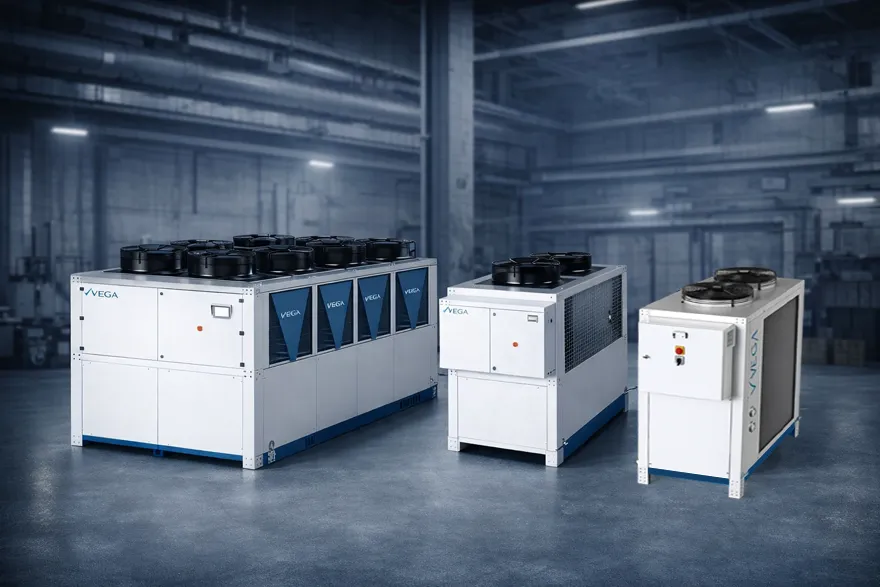
From industrial manufacturing to commercial buildings, from process lines to applications requiring precise temperature control, reliable cooling systems are critical across a wide range of sectors. One of the most prominent solutions in this field is the chiller cooling system. Particularly in operations where maintaining a constant temperature is decisive for quality, efficiency, and equipment safety, chiller systems are not merely auxiliary equipment; they are among the core infrastructure components that directly affect operational continuity.
Today, the term “chiller cooling” refers not only to a single unit, but to an integrated system engineered to deliver controlled cooling, based on technical calculations and tailored to the specific application. For this reason, approaching the subject solely from the perspective of equipment definition is not sufficient. Chiller cooling should be evaluated in conjunction with proper capacity selection, system design, energy efficiency, process requirements, and operating costs.
In this comprehensive guide, we will examine in detail what chiller cooling is, how it works, which components it consists of, where it is used, why it is critically important, and how the right system should be selected. Throughout the article, we will also explain—within a natural yet technical framework—why corporate expertise is essential in the field of industrial cooling.
What Is Chiller Cooling?
Chiller cooling is a mechanical cooling method based on the principle of cooling a liquid—typically water or a water-glycol mixture—to a specified temperature and then using that chilled fluid in a process, machine, production line, or air conditioning system. In its most basic form, a chiller system removes heat from an environment or piece of equipment by means of a circulating fluid. This makes it possible to maintain a defined temperature level and ensures that the system operates safely, efficiently, and consistently. In this respect, chiller cooling is not intended solely for comfort cooling; it also serves a strategic function in process control, quality assurance, and energy management. The answer to the question what is a chiller is closely related to the concept of chiller cooling. The chiller is the main unit that provides the cooling effect, while chiller cooling refers to the overall controlled cooling process generated by that unit.What Is the Purpose of Chiller Cooling Systems?
In many industries, the heat generated during operation must be kept under control. If this heat is not removed quickly and consistently enough, serious problems such as product quality deterioration, process errors, equipment failures, and production losses may arise. This is precisely where chiller cooling systems come into play. The primary functions of chiller systems include:- Removing heat generated by machinery and equipment
- Providing stable temperature control in production processes
- Preserving product quality
- Preventing equipment overheating
- Supporting cooling in central air conditioning systems
- Ensuring production continuity and process safety
- Contributing to energy efficiency
How Does Chiller Cooling Work?
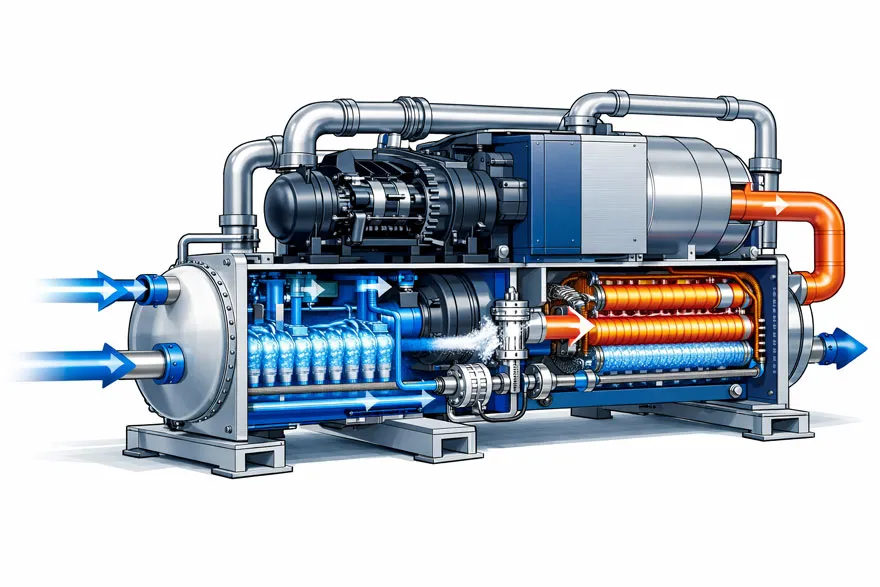
The chiller operating principle is fundamentally based on the vapor-compression refrigeration cycle. The system uses the pressure and temperature changes of a dedicated refrigerant to absorb heat on one side and reject it to the external environment on the other. Through this cycle, the water circuit is maintained within the desired temperature range. In simple terms, a chiller cooling system works as follows: first, the heat carried by the fluid to be cooled is absorbed into the system. Then, this heat is transferred to the outside environment through the chiller’s refrigeration cycle. As a result, the low-temperature fluid obtained is sent back to the process, and the cycle continues continuously.Key Stages of the Chiller Operating Principle
- Heat absorption in the evaporator: As the refrigerant evaporates under low pressure, it absorbs heat from the water circuit.
- Compression in the compressor: The refrigerant vapor is compressed by the compressor, increasing its pressure.
- Heat rejection in the condenser: The high-temperature refrigerant releases its heat to the external environment and condenses back into liquid form.
- Pressure reduction in the expansion device: The refrigerant pressure is reduced, preparing it to re-enter the evaporator under suitable conditions.
Main Components of a Chiller Cooling System
The performance of a chiller system depends not only on its total cooling capacity, but also on the quality of its main components, their correct matching, and their suitability for the intended application. For this reason, understanding the fundamental components of the system is essential for making a sound evaluation.Compressor
The compressor is at the center of the chiller system. It compresses the low-pressure refrigerant coming from the evaporator, increasing both its pressure and temperature. This process enables the refrigerant to reach the level required to reject heat in the condenser. Compressor selection has critical implications in terms of capacity, energy efficiency, noise level, and application type. Different compressor technologies such as scroll, screw, and centrifugal are preferred according to different capacity ranges and operating scenarios.Evaporator
The evaporator is the section where the actual cooling effect takes place. As the refrigerant evaporates here, it absorbs heat from the water or process fluid. As a result, the temperature of the circulating water is reduced, and chilled fluid is produced. In process cooling system applications that require precise temperature control, evaporator efficiency is particularly important, because temperature fluctuations can directly affect product quality.Condenser
The condenser is the section where the heat absorbed by the system is rejected to the external environment. Here, the high-temperature refrigerant coming from the compressor loses heat, condenses, and returns to liquid form. The operating method of the condenser varies depending on the chiller type. In air-cooled systems, ambient air is used with the help of fans. In water-cooled systems, this heat is generally rejected through a water circuit and cooling tower.Expansion Device
The expansion device reduces the pressure of the refrigerant so that it can enter the evaporator under suitable conditions. This allows the refrigerant to return to a lower temperature level and continue the cycle. Although it may appear smaller in size, the expansion device is vital to the balanced and efficient operation of the system. An improperly controlled expansion system can significantly reduce overall performance.Differences Between Air-Cooled and Water-Cooled Chillers
Chiller cooling systems are generally evaluated in two main categories: air-cooled chillers and water-cooled chillers. The most suitable type depends on facility conditions, required capacity, climate, infrastructure, energy strategy, and maintenance approach.Air-Cooled Chillers
In air-cooled chiller systems, heat is rejected to the external environment by means of air passing through the condenser. Thanks to their fan-assisted design, they can operate without the need for an additional cooling tower.- Relatively easier to install
- Do not require a cooling tower
- Do not consume water
- May offer a compact design
- May be more affected by outdoor ambient temperature
Water-Cooled Chillers
In water-cooled chiller systems, heat is carried away through condenser water. These systems are generally used together with a cooling tower and are particularly prominent in higher-capacity projects.- Can be suitable for high-capacity facilities
- May be less affected by outdoor ambient temperature
- Can deliver efficient performance under continuous and intensive operating conditions
- May require additional infrastructure and a more comprehensive maintenance plan
- Project-based installation costs may be higher
Where Are Chiller Cooling Systems Used?
Chiller cooling systems have a very broad range of applications. Today, temperature control is not only a need for major industrial plants, but also a shared requirement across commercial buildings, precision manufacturing environments, and various technical applications.Plastic Injection Facilities
In plastic injection lines, mold temperature must be controlled. Irregular cooling can extend cycle times and cause surface defects in the final product. For this reason, chiller systems are of major importance in plastic injection processes in terms of production quality and efficiency.HVAC and Central Air Conditioning
Chiller systems are used for central air conditioning in hotels, offices, hospitals, shopping centers, and large commercial buildings. In such applications, the chiller produces chilled water to ensure controlled cooling of indoor spaces.Process Cooling Applications
In operations requiring a process cooling system, temperature deviations can lead to serious quality issues. For this reason, chiller systems are used in laser machines, printing systems, reactors, CNC equipment, and various automation lines.Food and Beverage Industry
In food production, temperature control is critically important for both quality standards and production safety. Chiller systems provide stable cooling in production, processing, filling, and certain storage scenarios.Chemical Industry
In chemical production processes, reaction temperatures must be carefully controlled. At this point, chiller systems support process safety and help keep unwanted temperature increases under control.Pharmaceutical Manufacturing and Laboratories
Pharmaceutical production lines and laboratory environments require highly precise temperature control. In these applications, chiller systems help maintain stable operating conditions.Manufacturing Plants and Machine Cooling
In metalworking, electronics manufacturing, textiles, packaging, and many other production sectors, chiller cooling systems are used to ensure the continuous and safe operation of machinery.Why Is Chiller Cooling Critically Important in Industry?
In industrial facilities, temperature control is not merely a matter of comfort; it is directly related to quality, safety, and operational continuity. For this reason, chiller systems are one of the key factors working in the background while significantly determining production performance. The main reasons why chiller cooling systems are critically important include:- They help preserve production quality
- They support the service life of machinery and equipment
- They reduce the risk of unplanned downtime
- They provide process stability
- They offer advantages in energy management
- They improve overall operating efficiency
- They reduce temperature-related error rates