


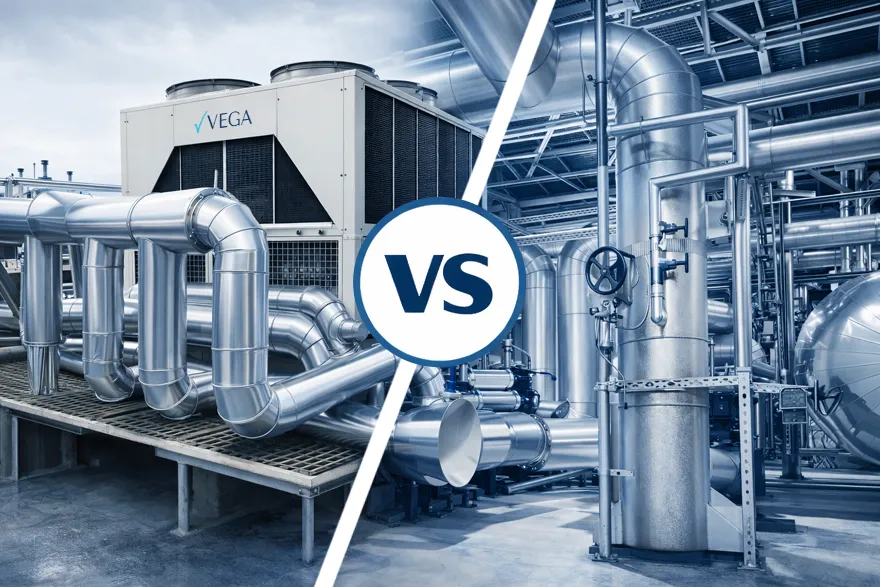
Air-Cooled vs Water-Cooled Chillers
Choosing between air-cooled and water-cooled chillers requires more than comparing unit COP. Climate, water availability, cooling-tower and pump energy, maintenance, space and total operating cost must be evaluated together.
Air-cooled arrangement
A fan-assisted condenser rejects heat to ambient air. This reduces the need for a tower-water circuit and associated treatment work. However, hot-air recirculation, sound constraints and high ambient temperature affect unit selection.
Water-cooled arrangement
The condenser transfers heat to a separate water circuit, which needs a tower or another suitable heat sink. Water use, water quality, tower maintenance and additional pump and fan power belong in the assessment. Compressor power alone does not represent complete plant efficiency.
Compare quotations at the same duty
Use the same cooling load, water temperatures and operating profile for both offers. List electricity, water, maintenance, installation requirements and capital cost separately. Neither technology delivers a universal fixed percentage saving in every facility.
| Criterion | Air-cooled | Water-cooled |
|---|---|---|
| Heat rejection | Ambient air and fans | Separate condenser-water circuit |
| Infrastructure | Air clearances and process loop | Heat sink, pumps and water treatment |
| Cost assessment | Unit and fan/pump energy | Unit, tower/pump energy and water costs |
Project inputs and calculation boundaries
For a quotation, specify approximate heat duty, fluid, inlet and outlet temperatures, flow, pressure loss and operating hours. Design ambient conditions, indoor or outdoor location and electrical infrastructure are also selection inputs. Flow and temperature readings must represent the same operating point. Do not transfer a catalogue capacity directly to different temperatures; confirm model performance at the required duty.
Commissioning and operating records
Check circuit cleanliness, filtration, air removal, proven flow and sensor readings. Record reference water temperatures and load conditions during commissioning. These values provide a baseline for maintenance and alarm investigations. Confirm pumps, tanks, connections and control options against the agreed quotation scope.
Frequently asked questions
Is the series capacity range sufficient for final selection?
No. Confirm the actual model at the required fluid temperature, ambient conditions, fluid properties and hydraulic duty.
Is cooling capacity the electrical consumption?
No. Cooling kW and electrical-input kW are different quantities. An energy assessment also needs actual load and operating hours.
What information is needed for a quotation?
Provide the industry or equipment, target temperature, approximate duty, flow, ambient conditions, operating hours and details of the existing system.
Technical reference
U.S. DOE — energy-efficient chiller assessment
These explanations provide general engineering guidance. Examples are not field measurements or performance guarantees for a particular model.