



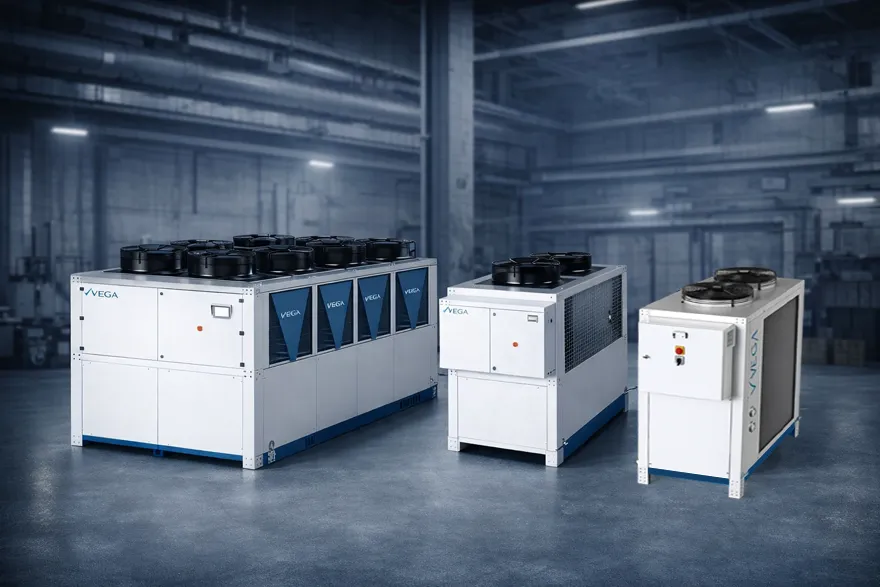
Air cooled chillers are central cooling systems widely used in industrial and commercial facilities, where heat transfer is achieved by using ambient air instead of water on the condenser side. In these systems, cooling is based on the principle of circulating refrigerant within a closed loop and rejecting the heat absorbed from the system to the atmosphere by means of fans.
Air cooled chiller systems are especially preferred in modern facilities because they do not require water consumption, do not need a cooling tower, and offer a compact design. Their ease of installation and low infrastructure requirements make them an attractive solution for many industries.
Particularly in regions with limited water resources, in projects where infrastructure costs need to be minimized, and in applications where simplified maintenance is a priority, air-cooled chiller systems stand out as an ideal solution.
How Does an Air Cooled Chiller System Work?
An air cooled chiller basically operates according to the vapor-compression refrigeration cycle. This cycle is based on the refrigerant circulating at different pressure and temperature levels, absorbing heat from the system and rejecting that heat to the outside environment.
When the system starts operating, the refrigerant inside the chiller continuously circulates in a closed loop. During this circulation, four main components play a critical role: the compressor, condenser, expansion valve, and evaporator.
1. Compressor
The compressor, which is the starting point of the refrigeration cycle, compresses the low-pressure, low-temperature refrigerant gas and turns it into a high-pressure, high-temperature state. This process increases the energy level of the refrigerant and makes it possible to reject heat to the outside environment in the next stage.
The compressor is one of the most critical components of an air-cooled chiller system. System performance, energy consumption, and efficiency depend largely on the compressor type and capacity. Screw, scroll, or reciprocating compressors may be preferred depending on the application requirement.
2. Condenser (Air Cooled)
The high-temperature refrigerant leaving the compressor is directed into the air-cooled condenser. At this stage, condenser fans operate and force ambient air through the condenser coils, transferring the heat carried by the refrigerant to the outside environment.
As the refrigerant releases its heat, it condenses and changes from gas phase to liquid phase. This stage is the defining feature from which the air-cooled chiller system takes its name. Since heat transfer is carried out entirely by air, no additional cooling tower is required.
3. Expansion Valve
The high-pressure liquid refrigerant leaving the condenser passes through the expansion valve, where it undergoes a sudden pressure drop. This pressure drop significantly reduces the refrigerant temperature and prepares it for evaporation.
The expansion valve controls the refrigerant flow rate and pressure balance within the refrigeration cycle, ensuring stable system operation. For this reason, a correctly selected expansion valve is of great importance to overall chiller performance.
4. Evaporator
The low-pressure, low-temperature refrigerant circulates through the evaporator and absorbs heat from the water used in the chiller system. During this heat transfer process, the refrigerant evaporates and the water temperature decreases.
This chilled water is then sent, via the pump system, to air handling units, fan coil units, or industrial process equipment within the facility. In this way, the desired temperature of the space or process is maintained.
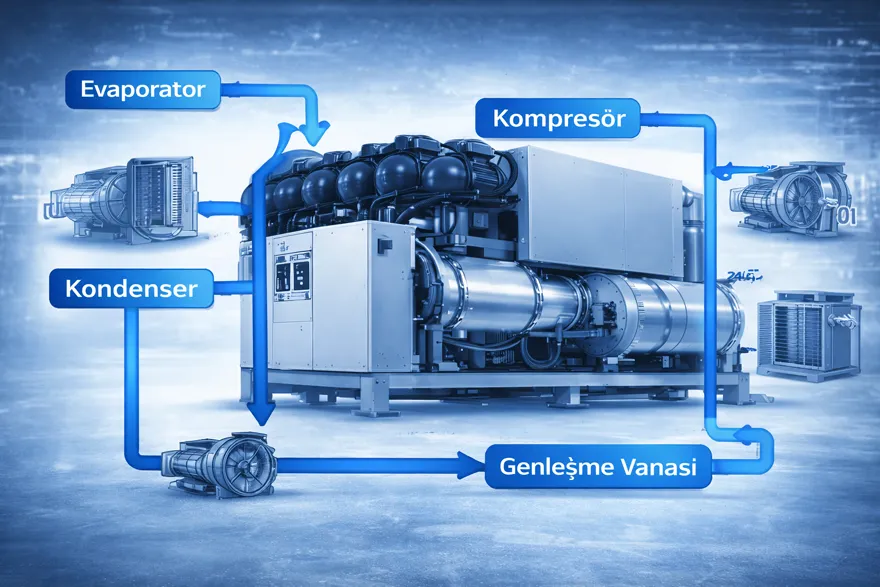
Main Components of an Air Cooled Chiller System
For an air-cooled chiller system to operate efficiently, all components must work in harmony with one another.
- Compressor
- Air cooled condenser coils
- Evaporator
- Expansion valve
- Axial or radial fans
- Circulation pumps
- Smart control and automation panel
- Refrigerant
Where Are Air Cooled Chillers Used?
Air cooled chiller systems are safely used across many industries thanks to their broad application range.
- Industrial manufacturing facilities
- Shopping malls and commercial buildings
- Hospitals and healthcare facilities
- Data centers
- Hotels and hospitality facilities
- Plastic injection and metal industry
- Food and beverage production facilities
Advantages of Air Cooled Chillers
Air-cooled chiller systems are a preferred choice for many businesses because of the multiple advantages they offer.
- No cooling tower required
- No water consumption
- Fast and easy installation
- Simpler maintenance procedures
- Lower initial investment cost
- Compact and modular design
Disadvantages of Air Cooled Chillers
- Efficiency may decrease at high outdoor temperatures
- Fan-generated noise levels are higher than in water-cooled systems
- Energy consumption may increase at larger capacities
How Should Air Cooled Chillers Be Selected?
Choosing the right air-cooled chiller system is critically important for ensuring long service life, efficient operation, and economic performance.
- Required cooling capacity (kW)
- Climate conditions of the facility location
- Energy efficiency values (COP / EER)
- Operating hours and load profile
- Service, maintenance, and spare parts support
Energy-Efficient Air Cooled Chiller Systems
Today, thanks to inverter compressor technologies, advanced control algorithms, and high-efficiency fan systems, air cooled chiller systems can operate with very low energy consumption.
With the right capacity selection, regular maintenance, and professional installation, operating costs can be significantly reduced while system performance can be maintained for many years.
Conclusion: Why Are Air Cooled Chillers Preferred?
Air cooled chiller systems are a reliable and sustainable cooling solution for many facilities thanks to their water-independent operation, ease of installation, and wide range of applications.
As Vega Chiller, we aim to deliver maximum efficiency, long service life, and high energy savings in industrial cooling through custom-designed high-performance air-cooled chiller solutions.