


What Does Periodic Chiller Maintenance Include?
So, what does periodic chiller maintenance include? Which equipment is inspected, which components are cleaned, and how should a professional maintenance procedure be carried out?
In this comprehensive guide, we will address all of these questions in full technical detail.
Importance of Chiller Maintenance in Industry
An industrial chiller unit directly affects product quality, production speed, and machine life by cooling processes operating at elevated temperatures. If chiller maintenance is neglected:
Energy consumption may increase by 20–40%,
Chiller capacity decreases,
Compressor failures may occur,
The condenser or evaporator may become clogged,
The unit may experience sudden shutdowns,
Production losses may occur.
For this reason, chiller maintenance plans play a critical role in industrial facilities in order to preserve heat transfer performance and extend equipment service life.
What Does Periodic Chiller Maintenance Include?
Periodic maintenance performed by a professional chiller service team is a technical process that involves the comprehensive inspection of all system components. The following sections outline the core elements of a standard chiller maintenance plan.
Filter Cleaning and Replacement
Filters in chiller systems capture dirt, particles, and contaminants on both the water side and the air side.
When filters become clogged:
Flow rate decreases,
ΔT changes,
Evaporator efficiency declines,
Energy consumption increases.
During periodic maintenance, water filters are removed, cleaned, or replaced when necessary. In air-cooled chillers, fan intake filters are also inspected.
Refrigerant Charge Inspection
Refrigerant charge plays a critical role in chiller efficiency.
When the refrigerant level drops:
Pressure values become unstable,
Evaporator efficiency decreases,
The compressor is placed under greater load,
Cooling capacity may decrease by up to 30%.
For this reason, refrigerant levels are checked during periodic maintenance, the system is tested for leaks, and refrigerant is recharged when necessary.
Oil Level and Oil Quality Inspection
Compressor oils both reduce friction and help cool the compressor.
A decline in oil quality may lead to:
Compressor failures,
Bearing damage,
Overheating.
During the maintenance process, the oil level is checked, oil analysis is performed, and the oil is replaced when necessary.
Condenser Cleaning
The condenser is the most critical heat transfer surface in a chiller.
A contaminated or clogged condenser may:
Trigger a high-pressure alarm,
Cause excessive fan operation,
Increase energy consumption by 30–50%,
Significantly reduce cooling capacity.
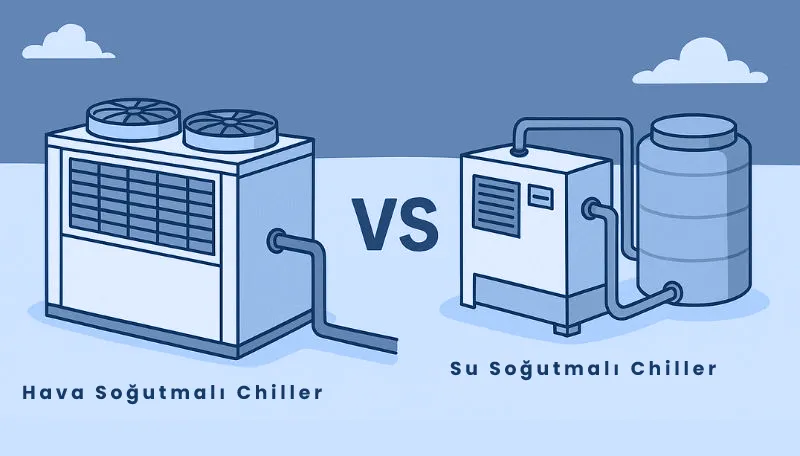
In air-cooled units, dust and dirt accumulated between the fins are removed using compressed air or specialized cleaning chemicals.
In water-cooled units, condenser coils are cleaned through chemical circulation procedures.
Evaporator Cleaning
If the evaporator surface becomes fouled, water-side heat transfer performance declines.
As a result:
The water may not reach the target temperature,
ΔT becomes unstable,
The chiller continues operating under high load.
During periodic maintenance, plate-type or shell-and-tube evaporators are cleaned, and scale and sediment deposits are removed.
Sensor and Temperature Probe Testing
Chiller systems incorporate numerous temperature sensors, pressure sensors, and flow sensors. Any malfunction in these sensors can disrupt the entire cooling cycle.
During the maintenance process, the following sensors are tested:
Water inlet/outlet temperature sensors
Refrigerant pressure sensors
Fan speed control sensors
Flow switch
Load sensors
Each sensor reading is checked using multimeters and digital test instruments.
Electrical Panel and Connection Inspections
The following components are inspected in the chiller electrical panel:
Thermal overload relays
Fuses
Cable connections
Phase protection relay
Compressor starter
Loose connections are tightened, damaged cables are replaced, and the interior of the panel is cleaned.
Pump, Fan, and Mechanical Component Inspections
During periodic maintenance, the pumps are checked for flow rate, pressure, and any signs of leakage. The fan motors are inspected for bearing condition, the condition of the fan blades, and operating noise levels.
Performance Measurement and Test Run
As the final stage of professional maintenance, the chiller is placed under a test run. The following parameters are measured:
Capacity (kW)
ΔT (inlet-outlet temperature difference)
Pressure values
Compressor current draw
Water flow rate
Fan speed
Refrigerant superheat values
These data reveal the unit’s actual operating performance.
Advantages of Periodic Chiller Maintenance for Your Business
Reduces energy consumption (approximately 20–40%).
Lowers the risk of breakdowns.
Prevents production downtime.
Extends compressor service life.
Improves ΔT and capacity stability.
Helps the unit operate close to its original performance level.
In systems where regular maintenance is not performed, compressor failures are among the most common high-cost problems.
What Should the Frequency of Chiller Maintenance Be?
The generally recommended periodic maintenance schedule is as follows:
Monthly: Filter inspection and pressure testing
Quarterly: General cleaning of the evaporator and condenser
Every 6 months: Refrigerant and oil inspection
Annually: Full-scale periodic maintenance
In heavy industrial facilities, maintenance intervals should be shorter.
Chiller Maintenance Should Be Performed by a Professional Service Team
Chiller units are engineered systems that operate under high pressure and include electrical and mechanical components. For this reason, maintenance should only be carried out by specialized chiller service teams. Improper maintenance may lead to:
Compressor failures,
Refrigerant leaks,
Energy losses,
Pressure-related problems.
Periodic Chiller Maintenance Is the Foundation of Operational Efficiency
A chiller maintenance plan is a comprehensive process that includes filter, refrigerant, and oil inspections, condenser and evaporator cleaning, sensor testing, electrical panel inspections, and performance testing. Regular maintenance helps the chiller:
Extend its service life,
Reduce energy costs,
Eliminate the risk of unexpected breakdowns,
Maintain stable process temperature control.
Regular chiller service is not merely maintenance for a business; it is an investment. At Vega Chiller, we deliver this service with the highest level of professionalism.