How to Select a Chiller ?
The question of
how to choose a chiller is one of the most critical decisions for businesses planning an industrial cooling investment. An incorrectly selected
chiller system can lead to serious issues such as insufficient cooling, high energy consumption, frequent breakdowns, production losses, and unnecessary capital cost. By contrast, a properly selected chiller unit delivers stable performance, energy efficiency, and reliable process control for many years.
Many users try to evaluate chiller selection based only on capacity or price. In reality, however, proper
chiller selection requires multiple technical factors to be considered together, including capacity calculation, process requirements, ambient conditions, energy targets, system type, and service infrastructure.
In this guide, we will examine in detail
how to choose a chiller, which criteria should be considered when selecting the right chiller, how to decide between air-cooled and water-cooled systems, which mistakes should be avoided, and how to determine the most suitable system for your operation.
Why Is Choosing the Right Chiller So Important?
An
industrial chiller is not simply a unit that cools water; it is also a critical infrastructure system that directly affects production quality, process continuity, and operating costs. For this reason, selecting a chiller is not just a purchasing decision, but also a long-term operational management decision.
A chiller selected with the wrong capacity may continuously struggle because it cannot meet the demand. On the other hand, an oversized chiller increases the initial investment cost and creates the risk of inefficient operation under low load. In addition, if a system is not selected according to ambient conditions, performance loss, component wear, and maintenance requirements may arise more quickly.
Advantages of Choosing the Right Chiller
- Stable cooling performance matched to the application
- Lower energy consumption
- Longer equipment life
- Fewer breakdowns and unplanned downtime
- Consistent process quality
- Lower total cost of ownership in the long term
The First Step in Chiller Selection: Determining the Cooling Requirement Correctly
The most important starting point in chiller selection is to determine accurately how much cooling capacity the system requires. Choosing a unit without making this calculation is a guess-based and risky decision.
Why Is Capacity So Critical?
The capacity of a chiller unit refers to the heat load that the system is capable of handling. This load varies depending on the number of machines, process temperature, fluid flow rate, ambient temperature, operating hours, and production intensity. In other words, capacity calculation should take real operating conditions into account, not just the number of units involved.
Main Factors Considered in Capacity Calculation
- Total heat load
- Entering and leaving water temperature values
- Fluid flow rate
- Number of machines or processes
- Ambient temperature
- Daily and weekly operating hours
If capacity is not calculated correctly, the chiller unit will either be insufficient or oversized. In both cases, the efficiency of the investment decreases.
Should You Choose an Air-Cooled or Water-Cooled Chiller?
One of the most important technical decisions in chiller selection is whether the system should be an
air-cooled chiller or a
water-cooled chiller. This choice should be made according to the physical conditions of the facility, required capacity, and available infrastructure.
When Should an Air-Cooled Chiller Be Preferred?
Air-cooled
chiller systems use ambient air on the condenser side. Because they do not require a cooling tower and offer easier installation, they are often the first choice in many facilities.
Situations Where They Are Advantageous
- Limited water infrastructure
- No desire to install a cooling tower
- Need for a more compact and faster installation
- Medium-capacity applications
When Should a Water-Cooled Chiller Be Preferred?
Water-cooled chiller systems can be advantageous especially in facilities requiring large capacities and in processes operating continuously under high load. However, in these systems, the water circuit, cooling tower, and maintenance infrastructure must be planned in greater detail.
Situations Where They Are Advantageous
- High-capacity demand
- Continuous operation under heavy load
- Energy efficiency as a priority
- Facilities with infrastructure suitable for a cooling tower
Technical Criteria to Consider in Chiller Selection
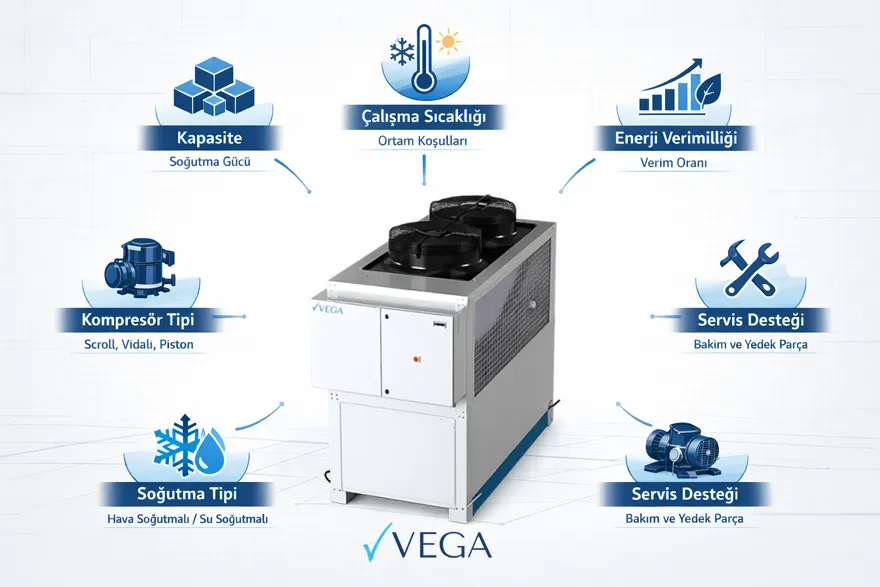
The right chiller is not selected based only on capacity and cooling type. The following technical criteria must also be evaluated together.
1. Operating Temperature Range
The temperature range in which the system will operate is very important. Some processes require highly precise temperature control. For this reason, the chiller unit must be able to maintain the target leaving water temperature consistently.
2. Ambient Conditions
Questions such as whether the unit will be installed indoors or outdoors, whether it will be exposed to high temperatures, and whether dusty or aggressive conditions are present all play a critical role in the selection process. Especially in regions with high outdoor temperatures, condenser performance must be assessed carefully.
3. Compressor Type
Scroll, reciprocating, and screw compressor options should be evaluated according to different capacity ranges and application requirements. One compressor solution may be more suitable for small and medium-scale systems, while another may be better for large and heavy-duty applications.
4. Energy Efficiency
In addition to the initial purchase cost of a chiller unit, its energy consumption is equally important. Systems with high efficiency ratings, proper control algorithms, and the ability to adapt to changing loads can significantly reduce operating costs in the long term.
5. Control and Automation
In modern chiller systems, not only cooling capacity but also alarm management, precise temperature control, remote monitoring, and automation integration are important. Advanced control systems provide major advantages, especially in facilities where process safety is critical.
6. Service and Spare Parts Support
A unit that appears technically sound can become a serious operational risk if after-sales support is weak. For this reason, the brand’s service network, technical response speed, and spare parts availability must be evaluated during chiller selection.
Common Mistakes in Chiller Selection
Many businesses make certain fundamental mistakes when selecting a chiller. Even if these mistakes are not noticed at the beginning, they often return later as performance and cost problems.
Most Common Mistakes
- Selecting a unit based only on price
- Making a decision without calculating capacity
- Failing to account for future capacity increases
- Ignoring energy efficiency
- Not questioning the service infrastructure
- Overlooking ambient temperature and installation conditions
- Failing to consider the need for redundancy
For this reason, the right approach is not simply to ask, “Which chiller is cheaper?” but rather, “Which chiller is the right investment for my operation?”
How Should Chiller Selection Be Made in Industrial Facilities?
In industrial facilities,
industrial chiller selection should be carried out in greater detail than in standard commercial applications, because in many cases the production line is directly dependent on the cooling system.
Priority Criteria in Industrial Selection
- Whether the process operates 24/7
- Whether the heat load is constant or variable
- Whether the machinery lineup may need to expand
- Whether precise temperature tolerance is required
- Whether production can stop during maintenance
In some facilities, a redundant chiller installation may be necessary. Especially in sectors where production stoppages are very costly, a redundant or multi-unit system design may be safer than relying on a single unit.
Why Should Energy Efficiency Be a Priority in Chiller Selection?
The purchase cost of a chiller unit represents only the initial investment. The true cost of the unit should be evaluated together with the energy it will consume over the years. For this reason, energy efficiency is one of the key priorities in chiller selection.
Benefits of an Energy-Efficient Chiller System
- Lower electricity bills
- More stable temperature control
- Longer equipment life
- Lower operating cost
- More sustainable production infrastructure
An efficient chiller system that may seem slightly more expensive at the initial investment stage can demonstrate its value within a few years through the savings it provides.
What Questions Should Be Asked When Selecting a Chiller?
To obtain the right proposal and the right unit, several basic questions must be clarified before making a selection.
Questions to Ask Before Making a Decision
- What is my total cooling load?
- What are my target entering and leaving water temperatures?
- Will the unit operate indoors or outdoors?
- Will the system operate continuously or periodically?
- How important is energy efficiency for me?
- Do I need a redundant system?
- How quickly can service support be provided?
Why Should You Work with Vega Chiller?
Vega Chiller works with an engineering approach that goes beyond simply supplying equipment. It analyzes the requirement, determines the right capacity, recommends the correct system type, and focuses on long-term efficiency. In this way, businesses obtain not just a chiller, but a professional solution tailored to their actual needs.
Every facility has a different load profile, temperature requirement, and operating condition. Vega Chiller takes these differences into account and provides project-specific, high-performance chiller solutions. This approach is the foundation of proper chiller selection.
What Is the Right Answer to the Question “How to Choose a Chiller”?
The correct answer to the question
how to choose a chiller is to evaluate capacity, ambient conditions, process requirements, energy efficiency, system type, and service support together. In other words, the right selection should not be made merely by looking at technical catalog data, but by analyzing the real needs of the application.
If you want to make the right
chiller selection for your business, you should focus not only on equipment price, but also on performance, durability, energy savings, and after-sales support together. As Vega Chiller, we provide professional support with high-performance and reliable industrial cooling solutions tailored to your needs.