Why Is a Chiller Necessary for Plastic Injection?
A
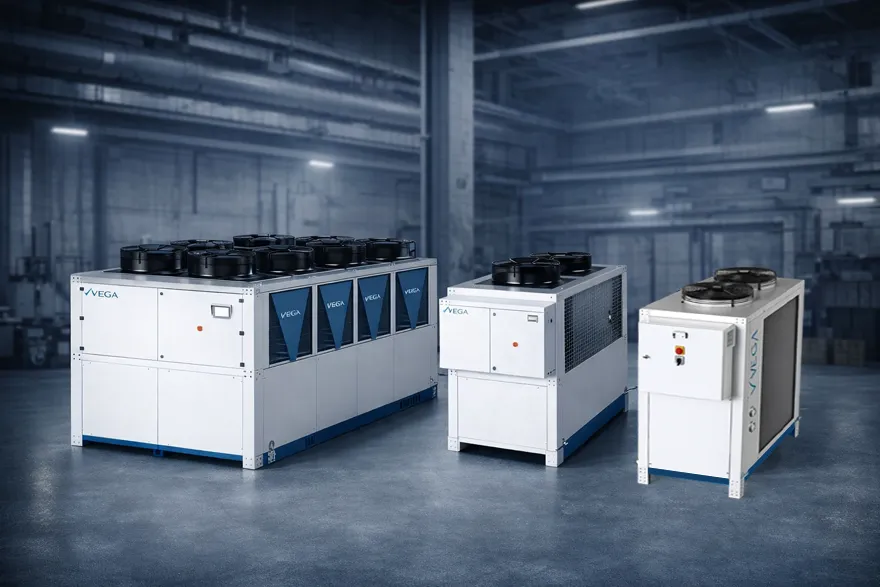
chiller for plastic injection is one of the most critical process cooling systems used to control mold temperature, reduce cycle time, improve product quality, and protect machine performance throughout the production process. In plastic injection manufacturing, temperature control is not merely a supporting factor; it is a critical variable that directly determines production efficiency.
In injection molding machines, molten plastic material is injected into the mold under high pressure. This material must then cool inside the mold in a controlled manner. If mold temperature is not managed properly, issues such as surface deformation, dimensional deviation, sink marks, flash, warpage, and process instability may occur. For this reason,
injection chiller systems are indispensable for high-quality and repeatable production.
In this guide, we will examine in detail why a
chiller for plastic injection is used, how a chiller works in injection molding machines, how to choose the right system, what advantages it offers, and how it contributes to production quality.
Why Is Cooling So Important in Plastic Injection Manufacturing?
In the plastic injection process, a significant portion of the total cycle time is spent in the cooling stage. No matter how powerful the injection machine may be, achieving the desired production speed and quality standard becomes difficult if mold temperature control is insufficient. For this reason, a chiller system is not simply a device that cools water; it is a strategic process component that directly affects production capacity.
Keeping the mold continuously within the same temperature range ensures consistent product quality in every cycle. This not only reduces scrap rates, but also makes production planning more predictable. Especially in the production of precision parts, engineering plastics, and high-volume output, the
plastic injection cooling system becomes even more critical.
Problems Caused by Insufficient Cooling
- Extended cycle time
- Product surface deformation
- Dimensional instability
- Part warpage and shrinkage issues
- Additional stress on the mold and machine
- Higher scrap rates and loss of quality
How Does a Chiller Work for Plastic Injection?
A
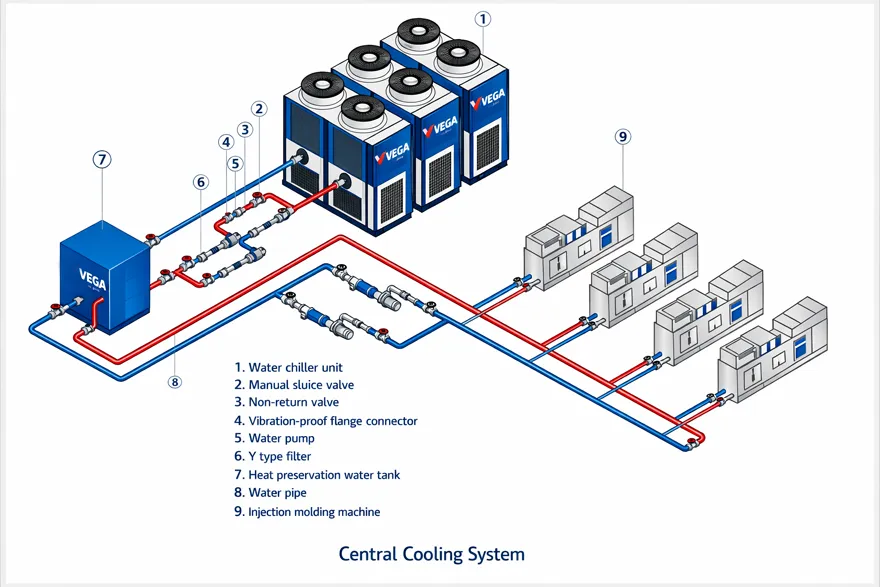
chiller for plastic injection supplies chilled fluid to the process by maintaining the water circulating through the mold cooling circuit at a specific temperature. The system absorbs excess heat from the mold through this water, and the chiller unit then rejects that heat to the outside environment. In this way, mold temperature remains under control.
The basic operating principle is as follows: the chiller cools the water to the required temperature. This chilled water is then sent, by means of a pump, to the mold channels in the injection molding machine. After absorbing heat inside the mold, the warmed water returns to the chiller unit. The chiller removes this heat from the system, cools the water again, and keeps the cycle running continuously.
Basic Operation of an Injection Chiller System
- The chiller cools the water
- Chilled water is sent to the mold circuit
- Heat from the mold is transferred to the water
- The warmed water returns to the chiller through the return line
- The chiller cools the water again, and the cycle continues
Advantages of Using a Chiller for Injection Molding Machines
A properly selected
injection chiller system does more than just lower temperature in the production line; it also provides major advantages in terms of efficiency, quality, and cost control.
1. It Reduces Cycle Time
When the mold is cooled faster and in a more controlled manner, each production cycle is completed in less time. This means more parts can be produced within the same timeframe. In high-volume production in particular, this advantage has a direct impact on profitability.
2. It Improves Product Quality
Keeping mold temperature stable prevents quality variations between products. Surface quality, dimensional accuracy, and repeatability all improve. This is especially important for plastic parts with tight engineering tolerances.
3. It Reduces Scrap Rate
Unstable cooling can cause many quality defects in plastic parts. With a chiller system, cooling becomes more controlled and production errors are reduced. This lowers raw material waste and minimizes the need for rework or remanufacturing.
4. It Protects the Mold and the Machine
Overheating can shorten mold life and place additional stress on the injection molding machine. With proper cooling, equipment operates more steadily, wear is reduced, and maintenance intervals may be extended.
5. It Strengthens Process Control
Repeatability is extremely important in plastic injection manufacturing. The use of a chiller makes the process more predictable and helps maintain the same quality standard consistently.
What Should Be Considered When Selecting a Chiller for Plastic Injection?
The same chiller unit is not suitable for every injection molding line. In order to choose the right system, process characteristics, machine capacity, mold design, production pace, and ambient conditions must all be evaluated together.
1. Cooling Capacity
The first and most important criterion in chiller selection is capacity. The total heat load of the mold and the machine must be calculated accurately. A chiller with insufficient capacity cannot maintain the required temperature, while an oversized system may create unnecessary investment cost and inefficient operation.
2. Mold and Process Structure
The number of molds, mold size, cycle time, properties of the plastic raw material used, and the target part quality are all decisive factors in system selection. Different molds may require different cooling demands.
3. Water Outlet Temperature
The required leaving water temperature provided by the chiller must be determined according to the desired process temperature. Some applications require more precise temperature control. For this reason, the ability of the unit to maintain stable temperature is critically important.
4. Operating Time and Load Profile
Questions such as whether the system will operate continuously, be used periodically, or support shift-based production all affect the selection. In injection plants operating 24/7, more durable and reliable systems should be preferred.
5. Energy Efficiency
In injection facilities, chiller systems may run for long hours. For this reason, a highly energy-efficient system provides a major long-term cost advantage. The focus should not be only on the initial investment cost, but on the total operating cost.
6. Service and Spare Parts Support
Since production stoppages can lead to serious losses, after-sales service support is extremely important. It is a major advantage when the chiller unit is supplied by a brand that offers fast technical service and reliable spare parts availability.
Is an Air-Cooled Chiller Suitable for Plastic Injection?
In many facilities,
air-cooled chiller systems are a highly suitable solution for plastic injection applications. Because they do not require water infrastructure, do not need a cooling tower, and offer a more compact configuration, they provide practical installation advantages.
Air-cooled chiller systems are widely preferred, especially in medium-scale injection lines, independent process cooling applications, and facilities that want to keep maintenance infrastructure simple. However, in very large plants operating under continuously heavy loads and requiring very high capacities, a project-specific evaluation is necessary.
Advantages of Air-Cooled Systems
- No cooling tower required
- Faster installation
- No water consumption
- More practical maintenance infrastructure
- Ideal for independent process lines
Is It Possible to Operate Plastic Injection Production Without a Chiller?
Theoretically, alternative cooling methods may be used in some low-precision production scenarios; however, for professional and sustainable manufacturing, a
chiller for plastic injection has almost become a standard. This is because expectations for speed, quality, and repeatability are very high in modern production.
Without a chiller, it becomes difficult to maintain mold temperature consistently. This may lead to fluctuations in product quality, longer cycle times, and higher scrap rates. For this reason, a chiller system offers a major advantage, especially for businesses producing at a commercial scale.
Common Mistakes When Selecting a Chiller for Plastic Injection
Many businesses focus only on unit price or general capacity information when selecting a system. This can lead to performance losses and operational problems in the long run.
Most Common Mistakes
- Determining capacity based only on machine power
- Ignoring the number of molds and cycle time
- Overlooking energy efficiency
- Failing to evaluate service support
- Ignoring ambient temperature and installation space
- Not planning for future capacity increases
The right approach is not simply to ask, “Which unit is affordable?” but rather, “Which system will deliver the most suitable performance for my production line?”
How Does Chiller Use Affect Production Costs in Plastic Injection Facilities?
At first glance, a chiller investment may appear to be an additional cost; however, the right system provides major long-term advantages. Shorter cycle times, lower scrap rates, more consistent quality, and fewer machine-related issues can all help reduce total production cost.
Cost Advantages of Using a Chiller
- Faster production cycles
- Fewer quality defects
- Lower raw material waste
- Less unplanned downtime
- Longer mold and equipment life
Why Vega Chiller?
Vega Chiller delivers stable, reliable, and efficient cooling solutions for the needs of plastic injection processes through a project-specific engineering approach. Every injection line has different capacity requirements, production rates, and temperature demands. For this reason, instead of a standard equipment approach, selecting and designing the right system for the process is critically important.
Vega Chiller offers long-lasting solutions for injection manufacturing facilities through accurate capacity calculation, the use of high-quality components, energy-efficiency-focused design, and strong after-sales support.
Why Is a Chiller Indispensable for Plastic Injection?
A
chiller for plastic injection is a core cooling system that increases production speed, improves quality, reduces scrap, and strengthens process control. Maintaining stable mold temperature in injection molding machines is one of the most important parts of modern manufacturing standards.
If you are looking for the right
injection chiller solution for your facility, you should focus not only on equipment price, but also on capacity, energy efficiency, process suitability, and technical support together. As Vega Chiller, we provide professional support with high-performance and reliable chiller systems specifically designed for plastic injection manufacturing processes.