What Is the Operating Principle of a Chiller?
The
operating principle of a chiller is based on a refrigerant circulating within a closed loop, absorbing heat from one environment and rejecting that heat to another. In simple terms, chiller systems remove unwanted heat in a controlled manner, cool the water or process fluid, and deliver that chilled fluid to the point where it is needed.
Today,
chiller systems are widely used in industrial facilities, production lines, commercial buildings, hospitals, hotels, data centers, and HVAC applications. The main reason for this is that temperature control is critical not only for comfort, but also for performance, product quality, system safety, and energy efficiency.
In this article, we will explain in a detailed and clear way
how a chiller works, which main components make up the system, what the compressor, condenser, evaporator, and expansion valve do, and how the operating logic differs between air-cooled and water-cooled systems.
How Does a Chiller System Work?
A
chiller system basically operates through the vapor-compression refrigeration cycle. This cycle consists of four main stages and forms the core of the system. The chiller unit removes heat from the process or HVAC line with the help of a refrigerant and transfers that heat to the outside environment.
The refrigerant circulating within the system continuously changes phase at different pressure and temperature levels. At times it is in gas form, and at other times in liquid form. This phase change is what makes heat transfer possible. That is the essence of the chiller operating principle.
Main Steps in the Chiller Operating Cycle
- Heat is absorbed from the water or process in the evaporator
- The compressor compresses the refrigerant gas
- The condenser rejects this heat to the outside environment
- The expansion valve reduces the refrigerant pressure
- The cycle begins again
Main Components of a Chiller System
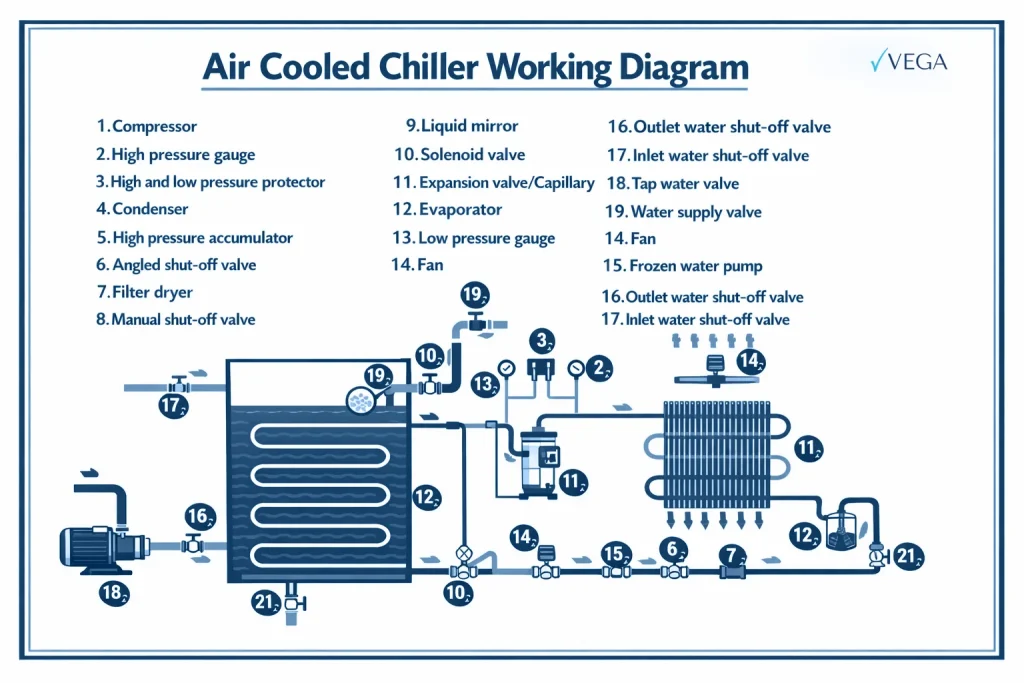
To properly understand the
operating principle of a chiller, it is first necessary to know the main components of the system. Each component manages a different stage of the heat transfer cycle.
1. Compressor
The compressor is the most important component of the chiller system and is generally described as the heart of the system. The low-pressure, low-temperature refrigerant vapor leaving the evaporator enters the compressor. The compressor then compresses this gas, turning it into a high-pressure, high-temperature refrigerant.
This process increases the energy level of the refrigerant and makes it possible for the refrigerant to reject its heat to the external environment in the condenser. Scroll, reciprocating, and screw compressors are among the most commonly used compressor types in chiller systems.
The Role of the Compressor in the System
- Circulating the refrigerant through the cycle
- Increasing the refrigerant pressure
- Maintaining the continuity of the heat transfer cycle
2. Condenser
The high-temperature, high-pressure refrigerant vapor leaving the compressor reaches the condenser section. The role of the condenser is to reject the heat carried by this refrigerant to the outside environment. As the refrigerant loses heat, it condenses and turns into a liquid.
If the system is an
air-cooled chiller, outdoor air is used in the condenser with the help of fans. If the system is a
water-cooled chiller, water circulation and, in most cases, a cooling tower are used on the condenser side. For this reason, the condenser is the main section of the chiller system where heat exchange with the environment takes place.
The Role of the Condenser in the System
- Rejecting the refrigerant heat to the outside environment
- Converting the refrigerant from gas to liquid
- Maintaining the system’s heat rejection balance
3. Expansion Valve
The high-pressure liquid refrigerant leaving the condenser enters the expansion valve. Here, the refrigerant pressure is reduced in a controlled manner. As the pressure drops, the refrigerant temperature also decreases, making it ready to provide cooling before entering the evaporator.
Because the expansion valve regulates the amount of refrigerant entering the system, it is extremely important for chiller performance. A malfunctioning expansion valve can reduce system efficiency and cause unstable operating conditions.
The Role of the Expansion Valve in the System
- Reducing the refrigerant pressure
- Preparing the refrigerant for the evaporator
- Controlling flow rate and cycle balance
4. Evaporator
The evaporator is the point where the actual cooling takes place in the chiller system. The low-pressure, low-temperature refrigerant coming from the expansion valve absorbs heat from the process water or the fluid to be cooled inside the evaporator. During this process, the refrigerant evaporates.
The water that has its heat removed inside the evaporator is cooled and sent into the system with the help of a pump. For example, this chilled water may be supplied to an air handling unit, fan coil line, production machine, mold, or process tank. In this way, the chiller system performs its actual function.
The Role of the Evaporator in the System
- Absorbing heat from water or the process
- Producing chilled fluid
- Allowing the refrigerant to evaporate
Step-by-Step Chiller Operating Principle
To make the subject clearer, it is useful to look at the operating sequence of the chiller system step by step.
Step 1: Heat Is Collected in the Evaporator
The warm water returning from the system enters the evaporator. Here, the refrigerant absorbs heat from this water, and the water temperature decreases.
Step 2: The Refrigerant Vapor Moves to the Compressor
The refrigerant that evaporates in the evaporator reaches the compressor as a low-pressure gas. The compressor compresses the gas and raises its temperature.
Step 3: Heat Is Rejected in the Condenser
The high-temperature gas releases its heat to the outside environment in the condenser. The refrigerant then returns to liquid form.
Step 4: Pressure Is Reduced in the Expansion Valve
As the liquid refrigerant passes through the expansion valve, its pressure drops, its temperature decreases, and it becomes suitable to re-enter the evaporator.
Step 5: The Cycle Continues Continuously
This cycle repeats continuously within seconds. In this way, the chiller unit provides stable and controlled cooling.
The Difference Between the Operating Principle of Air-Cooled and Water-Cooled Chillers
The basic refrigeration cycle is the same in both systems. The difference lies in how heat is rejected on the condenser side.
Air-Cooled Chiller
In these systems, fans are located on the condenser side. The fans pass ambient air through the coils and reject the heat directly to the air. This configuration eliminates the need for a cooling tower.
Water-Cooled Chiller
In these systems, water is used on the condenser side. Heat is carried away by water and is often released to the atmosphere with the help of a cooling tower. This can provide a high-efficiency advantage in large-capacity applications.
Main Differences
- In air-cooled systems, heat is rejected to outdoor air
- In water-cooled systems, heat is carried by a water circuit
- Air-cooled systems offer more practical installation
- Water-cooled systems can provide advantages in large-scale applications
In Which Applications Is the Chiller Operating Principle Important?
The correct operation of a chiller system is important not only for providing cooling, but also for process safety and product quality.
Main Application Areas
- Plastic injection and extrusion machines
- Laser cutting and CNC machines
- Chemical and pharmaceutical production facilities
- Food production lines
- Data centers
- Hotels, shopping malls, and commercial buildings
- Hospitals and precision air conditioning environments
Especially in industrial manufacturing, even a difference of a few degrees can affect product quality. For this reason, proper implementation of the chiller operating principle and professional system design are critically important.
Factors That Affect Chiller Performance
Although the basic operating principle remains the same, the actual performance of a chiller system is influenced by many technical details.
Main Performance Factors
- Correct capacity selection
- Compressor efficiency
- Condenser and evaporator cleanliness
- Proper refrigerant charge
- Regular maintenance
- Suitable control system and automation
- Ambient temperature and operating conditions
Incorrect capacity selection or inadequate maintenance can cause performance loss even in the best chiller system. For this reason, the operating process is just as important as the system design.
Why Is Regular Maintenance Required in Chiller Systems?
Because the chiller operating principle is based on a continuous cycle, each system component must perform at a high level over a long period of time. Problems that may occur in components such as the compressor, fan, sensors, condenser surface, evaporator, and expansion valve will reduce system efficiency.
Benefits of Regular Maintenance
- Maintains energy efficiency
- Reduces the risk of breakdowns
- Prevents cooling capacity loss
- Extends equipment life
- Reduces unplanned downtime
Items That Should Be Checked During Maintenance
- Refrigerant pressures and temperature values
- Fan and compressor operating condition
- Electrical connections and control panel checks
- Water circuit flow and filter cleanliness
- Condenser and evaporator surface cleaning
Why Vega Chiller?
Vega Chiller focuses not only on equipment manufacturing in the field of industrial cooling, but also on the right engineering approach, efficient system design, and long-lasting solutions. In order for the chiller operating principle to be applied efficiently in the field, unit design, component quality, and control infrastructure must be evaluated together.
Thanks to project-specific chiller solutions, accurate capacity calculation, strong technical support, and a solid after-sales service approach,
Vega Chiller provides reliable and sustainable cooling systems for businesses.
Why Should the Chiller Operating Principle Be Well Understood?
When the
chiller operating principle is well understood, system selection becomes more accurate, performance expectations are defined more clearly, and maintenance processes are managed more consciously. This cycle, consisting of the compressor, condenser, evaporator, and expansion valve, forms the foundation of modern cooling technology.
If you also want to select the right
chiller system for your facility and are looking for a technical yet clear answer to the question
how does a chiller work, the system components, capacity requirements, and operating conditions must be evaluated together. As
Vega Chiller, we provide professional support for your business with high-performance and reliable industrial cooling solutions.