Applications
Chiller Cooling for Hospitals and Healthcare Facilities: A Comprehensive Application Guide for 24/7 Uninterrupted Comfort, Hygiene, and Critical Area Control
Hospitals and healthcare facilities go far beyond the standard “comfort building” category in the HVAC world. In these environments, climate control is not limited to regulating temperature; it also means supporting infection control, maintaining stability in critical areas, ensuring the uninterrupted operation of medical equipment, and delivering reliable 24/7 performance. Areas such as operating rooms, intensive care units, sterile zones, laboratories, diagnostic imaging units, and pharmaceutical storage rooms require precise temperature and humidity ranges. In addition, fresh air volume, pressurization strategies, and filtration requirements are far more critical than in standard commercial buildings.
For this reason, chiller cooling applications for hospitals and healthcare facilities are among the core infrastructure components of modern hospital projects. Chiller-based central cooling systems can reliably manage high cooling capacities, provide flexible distribution across different zones, operate continuously through N+1 redundancy configurations, and optimize energy consumption through BMS integration. VEGA Chiller aims to deliver long-lasting central cooling solutions for healthcare facilities through proper capacity planning, redundancy architecture, hydronic system design, BMS integration, a hygiene-focused operational approach, and planned maintenance strategies.
In this comprehensive guide, we examine the use of chiller systems in hospitals, the criteria for proper chiller selection, HVAC requirements for critical areas, energy-efficiency strategies, and maintenance discipline at a professional engineering level.
Why Are Chillers Preferred in Hospitals and Healthcare Facilities?
In healthcare facilities, HVAC infrastructure is not a system that can simply stop operating. Backup generators are planned for power outages, critical equipment is designed with redundancy, and even maintenance procedures are organized in a way that does not interrupt operation. Chiller systems provide a centralized architecture suitable for this need for continuity and simplify control in large-scale buildings.
- 24/7 operation: Continuous and stable cooling capacity
- Critical area control: Precise management in zones such as operating rooms, ICUs, and laboratories
- Redundancy: Uninterrupted service with N+1 or 2N configurations
- BMS integration: Alarm management, trend monitoring, and energy tracking
- Scalability: Capacity expansion when new blocks or departments are added
- Maintenance management: Planned service and fast intervention with centralized equipment
Chiller Cooling Applications in Hospitals and Healthcare Facilities
In hospitals, the chiller system does not only supply comfort cooling areas; it also supports critical zones and technical spaces that are essential for medical processes. Therefore, applications are best evaluated under two main categories: “comfort HVAC” and “critical / technical cooling”.
1) Operating Rooms (HVAC + Humidity Control + Pressurization)
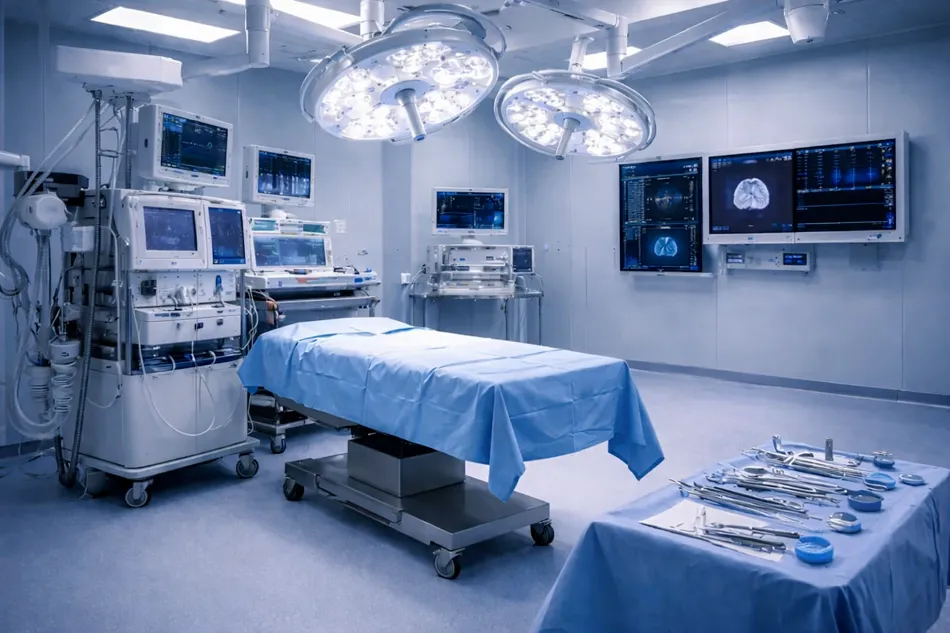
Operating rooms are among the most critical areas in hospital HVAC design. Temperature and humidity ranges are important for surgical team comfort, equipment performance, and infection control. Operating room AHUs condition the air using chilled water supplied by the chiller and help maintain the required humidity level.
Pressurization scenarios (positive-pressure operating rooms, corridor pressure relationships), filtration, and fresh-air ratios are integral parts of the design. The chiller system ensures stable performance at AHU coils, helping maintain reliable environmental control.
2) Intensive Care Units and Critical Care Areas
In intensive care units, environmental stability is directly related to patient safety. Stable temperature, correct humidity range, and high air quality support clinical processes. Zone-based control can be achieved with AHU/FCU integration. The chiller system should be designed with redundancy to ensure uninterrupted cooling in ICU zones.
3) Laboratories and Analysis Areas
Temperature stability in laboratories is critical for equipment calibration, sample stability, and measurement accuracy. Many devices (incubators, analyzers, reagent storage units) are sensitive to ambient conditions. Chiller-supported central cooling helps laboratory HVAC systems operate reliably.
4) Imaging Units (MRI / CT etc.) and Technical Cooling Infrastructure
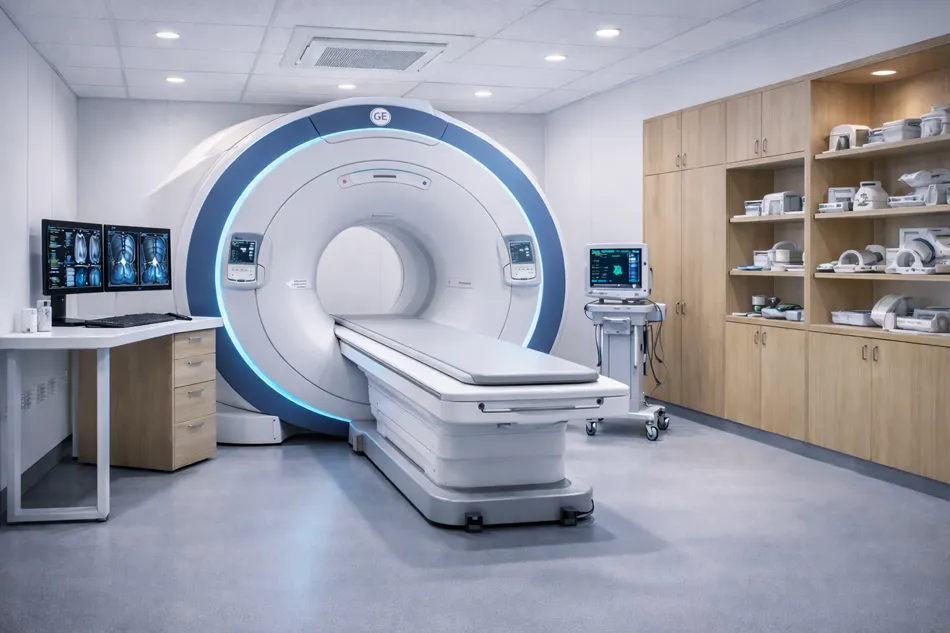
In imaging centers, uninterrupted operation of equipment is critical. While HVAC systems manage ambient conditions, technical cooling requirements of devices must also be considered separately. In some projects, dedicated cooling circuits or separate chillers may be required. (Device-specific cooling requirements must always be verified according to manufacturer documentation.)
5) Clinics, Patient Rooms, and Common Areas (Comfort Cooling)
Comfort cooling is required for patient rooms, outpatient clinics, waiting areas, and administrative zones. Fan-coil units (FCU) or AHU/VAV systems operate with chilled water supplied by the chiller. Zoning allows different control strategies depending on usage scenarios.
6) Pharmacy, Storage, and Cold-Chain Areas (Special Requirements)
Some healthcare facilities require temperature-controlled storage for pharmaceuticals and medical supplies. Infrastructure may vary depending on the project. The central chiller system can support these areas with appropriate heat exchangers and terminal units.
Application Note: Humidity Control and Condensation Risks in Healthcare Facilities
Humidity management in hospitals is not only about comfort. High humidity may cause mold risk, condensation on surfaces, and corrosion, while low humidity may negatively affect patient comfort and clinical procedures. In chiller + AHU systems, dehumidification capacity and control strategy are critical parts of the design.
Chiller Selection in Hospitals: Capacity, Redundancy, and Reliability
Chiller Capacity Calculation: Load Analysis Specific to Healthcare Facilities
Chiller capacity calculation must be performed carefully in hospital projects. Hospitals operate 24/7, have high fresh-air rates, and critical zones have very low tolerance. Load analysis should consider building envelope, climate data, fresh-air volumes, internal heat loads, equipment loads, operating scenarios, and future expansion plans.
Incorrect capacity selection may lead to:
- Undersizing: Setpoint deviations in critical zones, comfort loss, and operational risks
- Oversizing: Unnecessary investment, low efficiency at partial load, high operating cost
N+1 / 2N Redundancy: The Basis of Continuous Operation
Failure of the cooling system in healthcare facilities is not only a comfort issue; it may affect the operation of critical areas. Therefore, N+1 redundancy is often considered the minimum standard, while 2N configurations may be required in highly critical projects. Redundancy should not only be applied to chillers, but also to pumps, electrical panels, and control systems.
Air-Cooled or Water-Cooled Chiller?
The selection depends on capacity, layout, water management, and energy targets:
- Air-cooled chiller: Easy installation, no water consumption, fast commissioning
- Water-cooled chiller: Higher efficiency at large capacities, but requires cooling tower and water treatment
In large hospital campuses, water-cooled systems may provide efficiency advantages, but require strict maintenance and water management. Final decisions should be based on total cost of ownership (CAPEX + OPEX).
Hydronic Design: The Key Factor for Stability in Hospital Chiller Systems
Hospitals are multi-zone buildings with long piping lines, multiple elevations, numerous terminal units, and strict control requirements. Even if the chiller capacity is correct, poor hydronic design may cause instability in critical zones.
Variable Flow Pumps (VFD) and Differential Pressure Control
Load conditions vary throughout the day. Some zones operate continuously while others run partially. Variable-flow pump control adjusts flow according to demand and reduces energy consumption. Differential pressure sensors and proper valve selection ensure balanced distribution of chilled water.
ΔT (Delta T) Optimization
The supply-return temperature difference directly affects chiller efficiency and pump energy. Low ΔT results in excessive flow and high pump power, while very high ΔT may cause insufficient cooling. The goal in healthcare facilities is to achieve optimal ΔT without compromising stability in critical zones.
Application Note: Dedicated Circuits for Critical Zones
In some projects, operating rooms, ICUs, or imaging zones may be designed with separate hydronic circuits or priority control to maintain stability even when system load fluctuates.
BMS Automation and Monitoring in Healthcare Facilities
BMS integration is essential not only for energy savings but also for operational safety. Temperature, humidity, pressure differentials, fresh-air flow, chiller performance data, and alarms must be monitored. Trend analysis allows early detection of performance deviations.
Setpoint Optimization and Outdoor Compensation
Adjusting chiller setpoints according to outdoor conditions reduces unnecessary compressor load. However, optimization must not compromise critical zone requirements.
Sequencing, Load Sharing, and Alarm Management
In multi-chiller systems, automation should operate units in the most efficient combination. Alarm management must warn maintenance staff before critical zones are affected.
Energy Efficiency in Hospital Chiller Operation
Part-Load Efficiency and Inverter Technology
Inverter-driven pumps and fans reduce energy consumption at low load. Proper staging of multiple chillers improves part-load efficiency.
Heat-Transfer Surface Cleanliness
Dirty condenser or evaporator surfaces cause capacity loss and higher energy consumption. Regular cleaning and monitoring are essential.
Proper Dehumidification Strategy
Incorrect humidity control may increase cooling energy consumption. Coil sizing, reheat strategy, and control logic must be designed carefully.
Maintenance and Service Planning in Healthcare Facilities
Maintenance cannot follow a reactive approach. Preventive maintenance and documented schedules are mandatory. Maintenance planning must consider redundancy and seasonal load conditions.
Periodic Maintenance Scope
- Condenser / evaporator cleaning and heat-transfer inspection
- Refrigerant pressure checks and leak testing
- Compressor oil level and oil quality checks
- Pump, fan, and electrical panel measurements
- Sensor calibration and alarm log analysis
- Flow rate and ΔT performance verification
SLA and Critical Spare Parts Management
Fast response is essential in healthcare facilities. Service agreements, spare parts planning, and remote monitoring help minimize downtime.
VEGA Chiller Approach to Hospital Cooling Projects
VEGA Chiller considers healthcare cooling systems as a complete solution including equipment selection, redundancy, hydronic design, automation, and maintenance discipline. The goal is to ensure stable operation in critical zones while maintaining energy efficiency and easy operation.
Survey and Design
Hospital zones, fresh-air requirements, climate data, and future expansion plans are analyzed to determine the optimal chiller configuration.
Commissioning and Performance Verification
During commissioning, flow rate, ΔT, setpoint stability, automation logic, and alarm scenarios are verified to ensure reliable real-life operation.
Hospital Chiller Cooling Ensures Clinical Continuity, Not Only Comfort
In hospitals, HVAC is a strategic infrastructure supporting infection control, patient safety, and critical operations. With correct capacity planning, N+1 redundancy, hydronic balancing, BMS automation, humidity control, and preventive maintenance, chiller cooling systems for hospitals and healthcare facilities provide reliable 24/7 operation and sustainable energy management.
VEGA Chiller delivers efficient, reliable, and long-life cooling solutions for healthcare facilities with an engineering-driven approach.