Applications
Chiller Cooling for Plastic Processing; Use of Chillers in the Plastic Injection and Plastic Cooling Industry
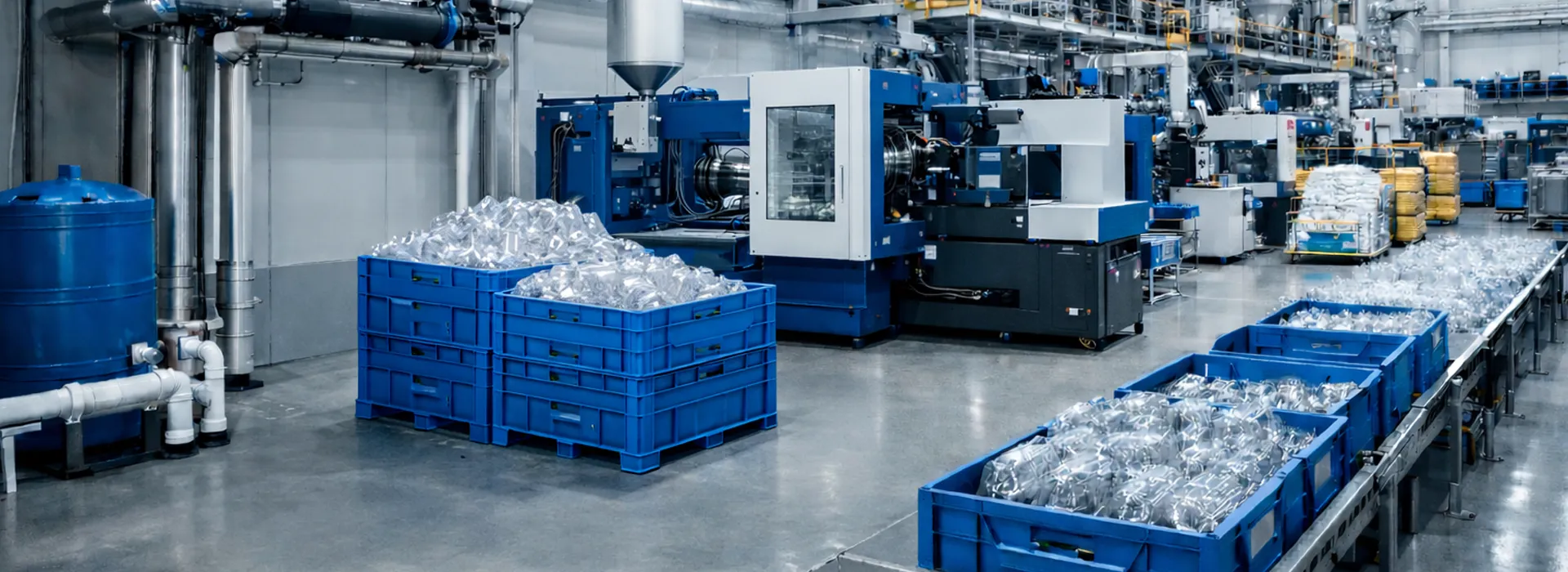
In plastic injection facilities, the two main indicators that determine production performance are cycle time and quality consistency. These two metrics are directly related to the quality of temperature control and heat transfer. During operation, the injection molding machine, mold, hydraulic systems, robotic auxiliary equipment, and extrusion lines generate significant heat. If this heat is not properly controlled, problems such as warpage, dimensional deviations, surface waviness, loss of gloss, increased flash formation, and reduced mold life may occur in the finished part.
This is where chiller-based plastic cooling infrastructure comes into play. A properly engineered industrial chiller keeps mold temperature stable, shortens cycle time, reduces scrap rates, and helps keep energy costs under control. In this guide, we examine the use of chillers in plastic injection processes, the correct system architecture, and the critical criteria for chiller selection through the engineering-driven approach of VEGA Chiller.
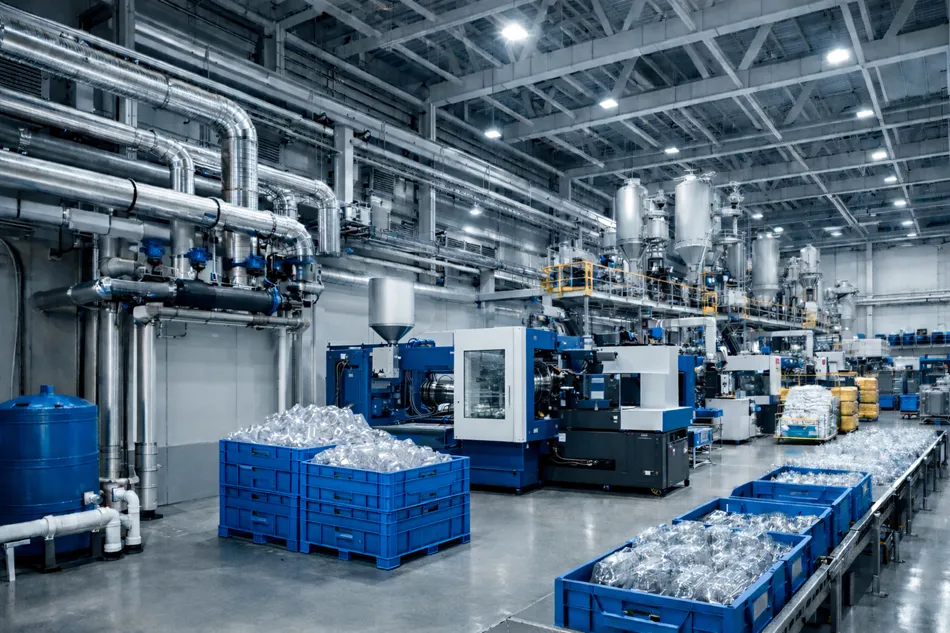
Chiller Cooling for Plastic Processing: Why Is Chiller-Based Plastic Cooling Critical in Injection Molding?
In plastic injection molding, the longest phase of the cycle is often the cooling stage. The molten plastic must be cooled in a controlled manner inside the mold until it reaches the required mechanical properties and dimensional stability. If cooling is insufficient, cycle time increases; if cooling is uneven, product quality fluctuates. For this reason, a chiller is not only a device that cools, but a control infrastructure that ensures the process operates in a repeatable and predictable manner.
Where Are Chillers Used in Plastic Injection Processes?
1) Mold Cooling Circuit
The mold is the thermal core of the process. Water or water–glycol circulating through the mold channels carries heat away and returns it to the chiller unit. The objective is to maintain mold temperature within tight tolerances and minimize part cooling time. Stable mold temperature directly affects quality, especially in high-gloss products, thin-wall parts, and tight-tolerance applications.
2) Hydraulic Oil Cooling of Injection Machines
An increase in hydraulic oil temperature leads to viscosity changes, pressure fluctuations, and loss of servo/hydraulic performance. The chiller controls oil temperature through a heat exchanger, helping the machine operate more stably. This application is particularly critical in high-tonnage machines and 24/7 production lines.
3) Extruder, Pelletizing, and Plastic Processing Lines
In extrusion and pellet production, temperature is one of the main parameters determining product characteristics. If heat is not properly managed in screw systems and die heads, surface quality may deteriorate, dimensional deviations may increase, and the line may become unstable. Industrial chillers remove heat from critical points along the line, ensuring process continuity.
4) Auxiliary Units, TCU Integration, and Process Tanks
Chillers also support mold temperature control units (TCU), robot gripper cooling, automation panels, and certain process tanks. In large facilities, centralized chiller systems allow multi-circuit management, simplifying maintenance and operation.
Technical Parameters That Determine Chiller Performance
Flow Rate and Pressure Management
If sufficient flow does not reach the mold circuits, heat transfer decreases, cooling time increases, and temperature fluctuations occur. Pump selection, manifold distribution, pipe sizing, and pressure losses must be calculated correctly. One of the most common mistakes in the field is installing a high-capacity chiller but having insufficient flow due to improper piping or pump selection. In VEGA Chiller projects, the system is considered as a complete hydronic infrastructure, not only as a single device.
ΔT (Delta T) Optimization
ΔT is the temperature difference between supply and return water. In plastic injection, the goal is to optimize ΔT according to process requirements to improve both quality stability and energy efficiency. If ΔT is too low, unnecessary pump energy and compressor load occur; if too high, mold temperature fluctuates and quality risks increase. Correct ΔT shortens cycle time while keeping energy consumption under control.
Water Quality, Filtration, and Scale Control
Scale and sediment buildup reduce heat transfer both in mold channels and heat exchanger surfaces. This results in capacity loss and higher energy consumption. Filtration, water treatment, and periodic cleaning are essential for sustainable plastic cooling chiller performance.
Engineering-Based Roadmap for Proper Chiller Selection
1) Analyze the Load Profile
How many machines operate simultaneously?
How many mold circuits per machine?
When do peak loads occur?
Is the process 24/7?
Is product variation high?
These parameters form the basis of the chiller capacity calculation. Incorrect sizing leads to either insufficient cooling or unnecessary energy consumption.
2) Central System or Machine-Based System?
Central chiller systems provide scale economy and easier maintenance in large facilities. Machine-based solutions allow independent operation of each line. In VEGA Chiller applications, the selection depends on expansion plans, production flexibility, and operational strategy.
3) Air-Cooled or Water-Cooled Chiller?
Air-cooled chillers offer fast installation and low maintenance. Water-cooled chillers provide higher efficiency in large capacities and continuous loads. The correct selection depends on ambient conditions, installation layout, energy targets, and available infrastructure.
Application Note: High Ambient Temperature and Capacity Safety
In hot climates or during summer, air-cooled systems may experience capacity loss. Therefore, design conditions must reflect real site conditions, and sufficient capacity margin must be ensured.
Benefits of Proper Plastic Cooling with Chiller Systems
Shorter Cycle Time
Stable mold temperature and correct flow management reduce cooling time, allowing higher production output from the same machine.
Lower Scrap Rate and Consistent Quality
Uniform cooling reduces warpage, surface defects, and dimensional deviations. Product quality becomes consistent, reducing rework and rejection costs.
Controlled Energy Consumption
Correct capacity sizing, proper ΔT, clean heat exchanger surfaces, and smart control reduce energy consumption. Periodic maintenance such as condenser/evaporator cleaning, filter inspection, and sensor verification prevents efficiency loss.
Application-Focused Engineering Approach with VEGA Chiller
For VEGA Chiller, the goal is not only to supply equipment but to measurably improve cooling performance. Therefore, site survey, process analysis, hydronic design, commissioning, and performance verification are carried out within a single engineering framework.
Site Survey and Process Analysis
Machine park, mold types, target temperatures, ambient conditions, and existing infrastructure are evaluated to adapt chiller selection and capacity sizing to real operating conditions.
Commissioning and Performance Verification
Flow, ΔT, temperature stability, and energy consumption are measured to optimize the system, ensuring stable operation under real production conditions.
In Plastic Injection, Chillers Are a Strategic Investment for Quality and Efficiency
In plastic injection and plastic cooling processes, the chiller is a strategic system that determines production quality, cycle time, and energy cost. A properly selected and correctly operated industrial chiller infrastructure enables higher capacity, lower scrap rate, and sustainable energy efficiency.