Applications
Chiller Cooling for Biogas Heat Exchangers: A Comprehensive Application Guide to Gas Cooling and Moisture Management in Biogas Plants
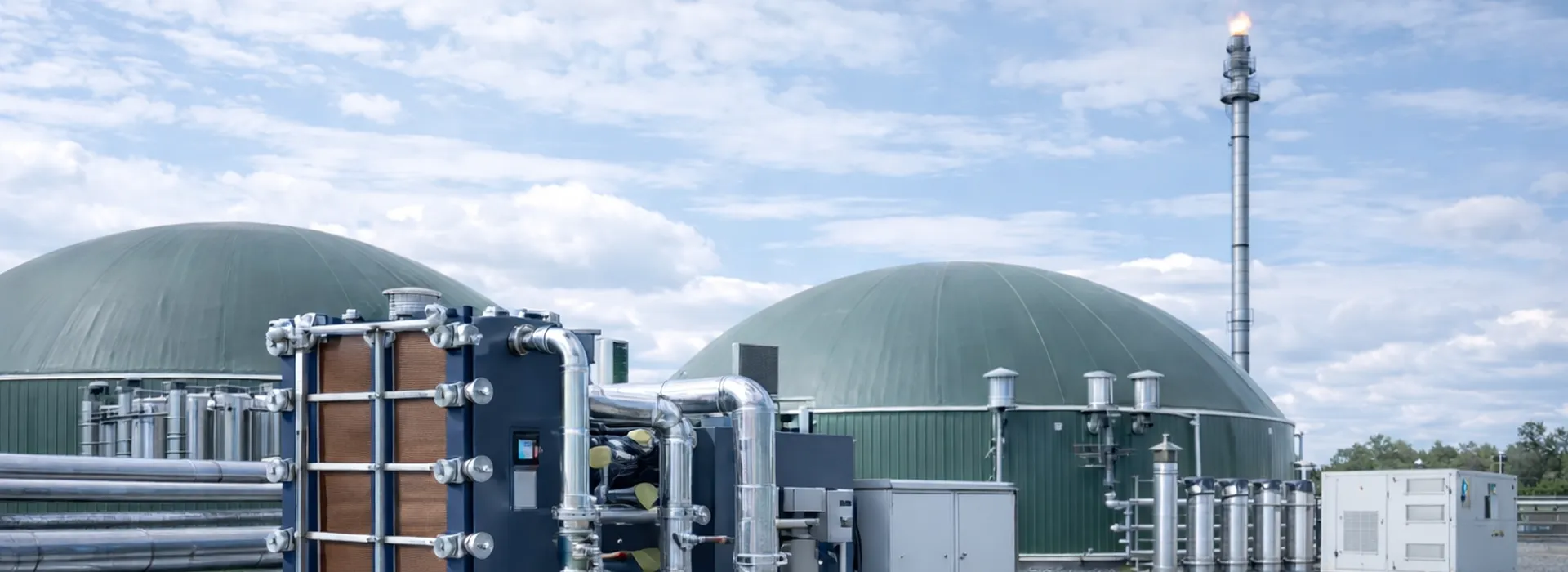
Biogas plants convert gas produced by the anaerobic digestion of organic waste into energy, reducing environmental impact while generating economic value. However, biogas is inherently a raw gas stream: high moisture, variable temperature, process-related particles, H₂S, and other trace components make it difficult to feed the gas safely into engines, generators, or upgrading systems. For this reason, gas conditioning stages are critical in biogas facilities.
At the core of gas conditioning is heat exchanger cooling. Controlled reduction of biogas temperature enables effective condensate management, allows moisture to be separated from the system, reduces the risk of corrosion and failure in downstream equipment, and improves overall process efficiency. This is where chiller-based biogas heat exchanger cooling systems come into play. A properly engineered industrial chiller infrastructure supplies a stable cooling medium to the gas cooler heat exchanger, ensuring the target outlet temperature and dew point are maintained consistently and reliably.
VEGA Chiller aims to provide sustainable and reliable cooling solutions for biogas applications through proper capacity planning, water-glycol circuit design, heat exchanger integration, automation and remote monitoring, and a preventive maintenance approach. In this comprehensive guide, we examine the purpose of biogas heat exchanger cooling, the role of the chiller, correct chiller selection, energy efficiency strategies, and maintenance practices at a professional engineering level.
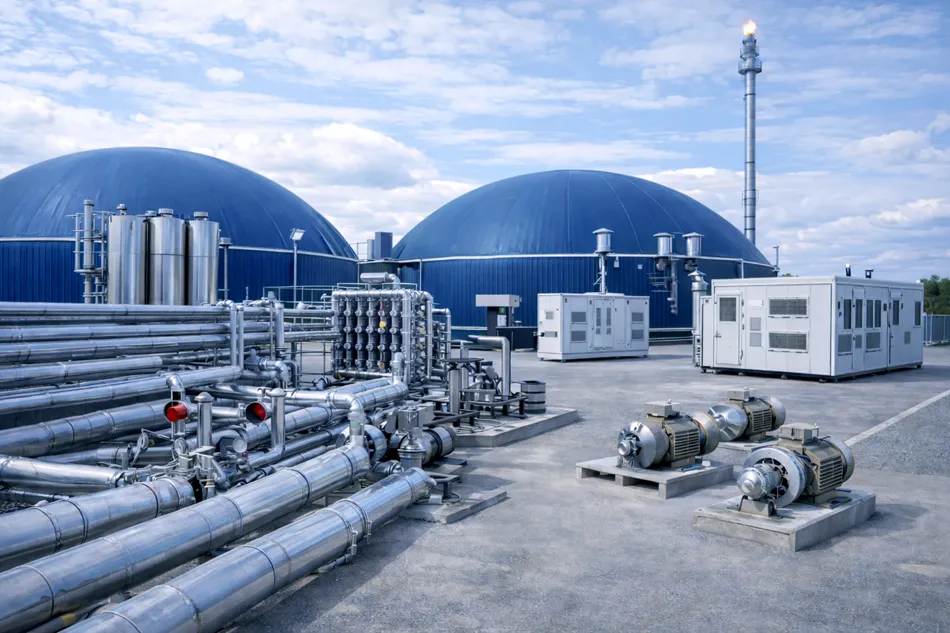
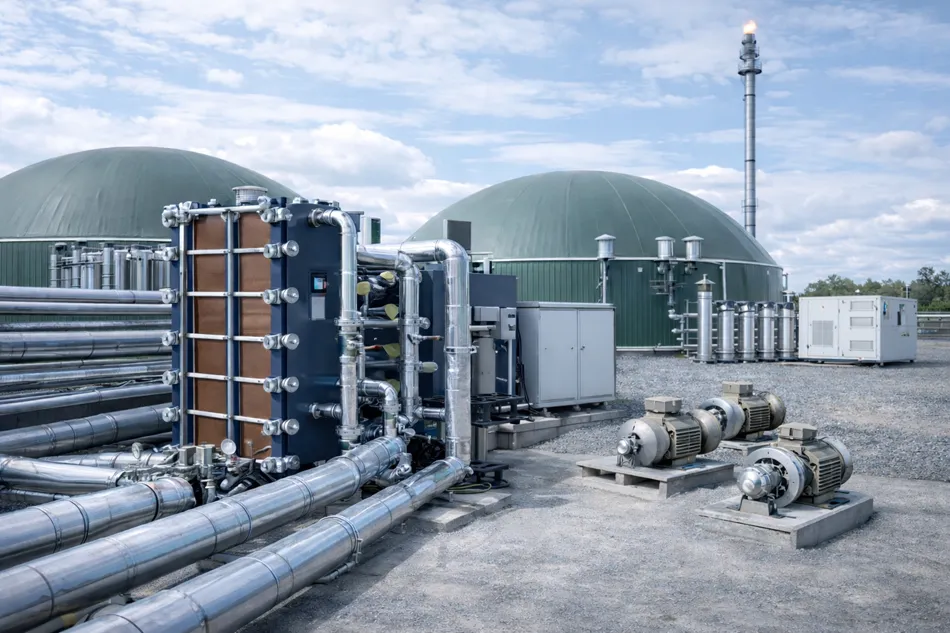
Chiller Cooling for Biogas Heat Exchangers: Why Is Heat Exchanger Cooling a Critical Process Step in Biogas Plants?
Biogas typically leaves the reactor at high temperature and high humidity. Water vapor contained in the gas travels throughout the system,
and as the temperature drops, this vapor condenses and forms condensate. Uncontrolled condensation can lead to accumulation in piping,
increased pressure loss, corrosion, and equipment damage. In biogas containing H2S, condensate may become acidic,
further increasing corrosion risk.
For this reason, the goal is to make condensation controlled, not accidental.
The gas cooling heat exchanger reduces the temperature in a planned manner, allowing moisture to separate,
while condensate separators, demisters, and drainage systems remove the liquid safely from the process.
The chiller acts as the primary cooling source that ensures stable operation of the heat exchanger.
- Reduces moisture load: Minimizes condensation risk in downstream equipment
- Reduces corrosion: Controls formation of acidic condensate
- Extends filter and equipment life: Reduces fouling and clogging risk
- Engine / generator safety: Provides more stable fuel gas quality
- Improves upgrading efficiency: Benefits CO2 separation, drying, and compression stages
Basic Architecture of a Chiller-Based Biogas Heat Exchanger Cooling System
In biogas heat exchanger cooling applications, the chiller produces a cooling water / glycol circuit and supplies it to the gas cooler heat exchanger.
The exchanger transfers heat from the biogas to the chiller loop, and the chiller rejects this heat to ambient air or water.
The system is controlled to maintain the required gas outlet temperature and condensation conditions.
Gas Cooling Heat Exchanger Types
Depending on flow rate, fouling tendency, material requirements, and maintenance access, different exchanger types may be used:
- Shell & Tube – robust for dirty gas, easy maintenance access
- Plate heat exchanger – compact but more sensitive to fouling
- Air-cooled gas cooler – performance depends on ambient conditions
Condensate Management and Drainage
Condensate formed during cooling must be safely removed.
Separators, demisters, and automatic drain systems keep the gas line dry and protect equipment.
Condensate chemistry (especially due to H2S) may influence material selection and disposal methods.
Application Note: Dew Point and Target Temperature
Cooling biogas to a defined temperature condenses part of the water vapor.
The target temperature must be selected based on the required dew point.
Too much cooling → higher energy consumption and excessive condensate
Too little cooling → condensation continues downstream
The goal is not the lowest temperature, but the correct temperature.
Typical Chiller Applications in Biogas Plants
Chiller-based biogas cooling solutions vary depending on gas utilization.
1) Gas Cooling Before CHP Engine Supply
Engines require dry and stable gas.
Moisture may cause condensation in intake lines, sensor faults,
combustion instability, and corrosion.
Heat exchanger cooling with a chiller improves gas conditioning
and increases engine reliability.
2) Pre-Conditioning Before Biogas Upgrading
In PSA, membrane, or chemical scrubbing systems,
temperature and moisture affect separation efficiency and compressor safety.
Stable cooling ensures predictable inlet conditions.
3) Compression and Storage Lines
Gas compression increases temperature,
changing condensation behavior.
Heat exchangers with chiller cooling allow controlled cooling after compression.
Chiller Selection: Capacity, Fluid, Material, Control
Capacity Calculation
Chiller capacity must be calculated based on:
• gas flow rate
• inlet / outlet temperature
• gas specific heat
• amount of condensate
• heat exchanger efficiency
Two load components exist:
- Sensible heat – cooling the gas temperature
- Latent heat – heat released during condensation
Ambient conditions, seasonal operation, and 24/7 duty must also be considered.
Incorrect sizing → unstable temperature or excessive energy use.
Water or Glycol?
Outdoor installations may face freezing risk.
Water-glycol mixtures improve safety.
Higher glycol ratio → higher viscosity → affects pump and heat transfer.
Fluid selection must be coordinated with hydronic design.
Air-Cooled vs Water-Cooled Chiller
Air-cooled chiller:
• simple installation
• no water system
• easy maintenance
Water-cooled chiller:
• higher efficiency at large capacity
• requires cooling tower
Selection depends on site conditions and energy targets.
Material and Corrosion Risk
Moisture and H2S increase corrosion risk.
Material selection, coating quality,
and condensate control are critical.
Water quality in the chiller loop also affects heat exchanger life.
Energy Efficiency in Biogas Cooling Systems
Chiller energy consumption directly affects plant profitability.
Common methods:
Part-Load Efficiency and Inverter Control
Variable load requires VFD fans / pumps
and staged capacity.
Setpoint Optimization
Too low temperature →
more condensate →
higher compressor load.
Correct target = required dew point with minimum energy.
Clean Heat Transfer Surfaces
Fouling reduces efficiency.
Regular cleaning maintains performance.
Application Note: Heat Recovery
In some plants, condenser heat can be reused.
Feasibility depends on project design.
Installation and Commissioning
Biogas plants may have harsh conditions:
outdoor installation, dust, humidity.
Important points:
• proper placement
• airflow
• pipe insulation
• drainage
• electrical protection
Pipe Insulation
Improper insulation → surface condensation → corrosion risk.
Automation and Alarm Strategy
Monitor:
• gas temperature
• supply / return temperature
• flow
• pressure
• electrical values
Alarm levels must protect engines / upgrading units.
Remote monitoring reduces response time.
Maintenance Strategy
Cooling failure may damage engines or upgrading systems.
Maintenance must be preventive.
- Condenser / evaporator cleaning
- Refrigerant pressure checks
- Compressor oil inspection
- Pump / fan / electrical checks
- Sensor calibration
- Flow and ΔT verification
- Heat exchanger fouling inspection
Predictive Maintenance
Trend monitoring allows early fault detection.
VEGA Chiller Engineering Approach
VEGA Chiller treats the chiller as part of the gas conditioning process.
Survey, load analysis,
heat exchanger integration,
glycol loop design,
automation,
commissioning,
maintenance
are planned together.
Goal:
• stable gas temperature
• controlled moisture
• protected equipment
• optimized energy use
Process Analysis
Flow, temperature,
dew point,
H2S,
exchanger type,
site conditions analyzed.
Commissioning
Gas temperature
condensate drainage
flow
ΔT
alarm logic
are verified.
Conclusion
Heat exchanger cooling in biogas plants
is essential for moisture control,
corrosion prevention,
and equipment safety.
Correct sizing,
fluid selection,
stable control,
proper condensate system,
and regular maintenance
ensure reliable gas conditioning.
VEGA Chiller provides efficient,
reliable,
long-life cooling solutions for biogas applications.