


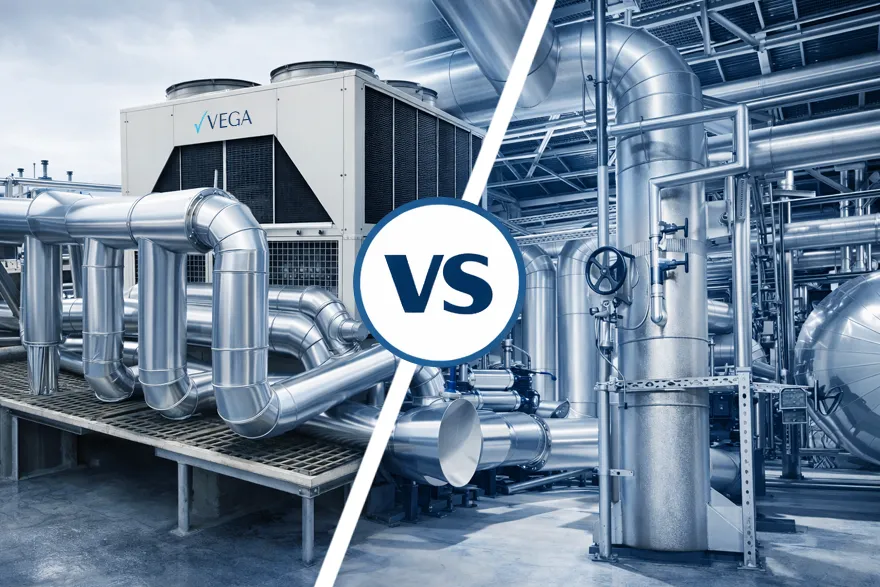
Air Cooled or Water Cooled Which Chiller Is More Efficient
One of the most critical components of an efficient production process in industrial facilities is temperature control. Proper temperature management directly affects both product quality and equipment service life. One of the most important systems used to maintain this control is the chiller cooling system. However, one of the most common questions businesses face is this:
Is an air-cooled chiller or a water-cooled chiller more efficient?
This question should be evaluated not only in terms of energy efficiency, but also with respect to installation, maintenance cost, operating expenses, capacity requirements, and environmental conditions.
In this comprehensive guide, we will compare these two chiller types in detail based on engineering principles, capacity calculations, field experience, energy-efficiency data, and industrial applications.
The Importance of Chiller Systems in Industry
Industrial chiller systems directly affect production continuity, energy efficiency, product quality, and equipment safety by maintaining the product, equipment, or process at a specified temperature. From plastic injection molding to the chemical industry, and from food production to HVAC applications, production in many sectors cannot continue without reliable cooling systems.
The efficiency of a chiller system can influence up to 30% of a facility’s total energy expenditure. For this reason, selecting the right system is critical to operational economics.
What Is an Air-Cooled Chiller?
In air-cooled chiller systems, the condenser coils are cooled by ambient air. With the help of fans, outside air is drawn across the unit, and the refrigerant in vapor form is condensed.
This system stands out particularly for its ease of installation, low maintenance cost, and compact design.
Air-Cooled Chiller Operating Principle
The hot refrigerant compressed in the compressor enters the condenser coil.
Fans force ambient air across the condenser.
The refrigerant rejects heat to the air and loses its thermal energy.
The refrigerant, now in liquid form, is directed to the expansion valve.
Heat exchange takes place in the evaporator, and the cooling cycle starts again.
Advantages of Air-Cooled Chiller Systems
Easy installation: They can be installed outdoors and require no additional infrastructure.
Low maintenance cost: There is no need for water-quality control, cooling tower cleaning, or water treatment.
Portability: Their modular and compact structure makes transportation easier.
Zero water consumption: Ideal for regions where water cost is high.
Low initial investment cost: More economical than water-cooled systems.
Disadvantages of Air-Cooled Chillers
They are highly affected by outdoor ambient temperature.
Capacity may decrease during summer conditions of 40–45°C.
Energy efficiency is lower than that of water-cooled systems.
They may not deliver the required performance in large-capacity projects.
What Is a Water-Cooled Chiller?
In water-cooled chiller systems, the condenser is cooled by water. This water rejects heat to the outdoor environment through a cooling tower. This system is the ideal solution for industries requiring high performance and stable operation under load.
Especially at high capacities, the water-cooled chiller is the most efficient solution.
Water-Cooled Chiller Operating Principle
The hot refrigerant coming from the compressor is cooled by water inside the condenser.
The heated water is sent to the cooling tower.
In the tower, the water is cooled and then returned to the system.
Continuous heat rejection and recirculation enable high operating efficiency.
Advantages of Water-Cooled Chillers
Very high energy efficiency: COP and EER values are 30–50% higher than those of air-cooled systems.
Minimally affected by temperature: Outdoor air temperature has little effect on performance.
Ideal for high-capacity requirements: Commonly used in capacities ranging from 300 kW to 2000 kW.
Stable performance: The most suitable chiller system for 24/7 operation in production facilities.
Disadvantages of Water-Cooled Chillers
Initial installation cost is high.
A cooling tower is required.
Water consumption is high.
Additional infrastructure such as tower, pumps, and piping is required.
Comparison of Air-Cooled and Water-Cooled Chiller Systems
| Criteria | Air-Cooled Chiller | Water-Cooled Chiller |
|---|---|---|
| Energy Efficiency | Moderate | Very High |
| Capacity Range | Small to Medium | Medium to Large |
| Maintenance Cost | Low | Medium |
| Water Consumption | None | High |
| Initial Investment | Low | Medium to High |
| Impact of Ambient Conditions | High | Low |
| Load Stability | Moderate | Very High |
Chiller Capacity Calculation: Which System Is More Efficient?
When performing a chiller capacity calculation, the differing operating conditions of these two chiller types must be taken into account.
Air-Cooled Capacity Calculation
Outdoor ambient temperature is the most critical factor.
Capacity should be calculated based on an outdoor design temperature of 45°C.
ΔT (typically between 3–7°C) is important.
Flow rate (m³/h) determines capacity.
Formula:
kW = 1.163 × Q × ΔT
Water-Cooled Capacity Calculation
Cooling tower efficiency must be considered.
Condenser water return temperature plays a major role in the design.
Capacity loss is very low.
It provides high operating stability.
For this reason, in capacity calculations, the water-cooled system is generally more reliable.
Which Chiller Should Be Selected for Which Industry?
Plastics Industry
An air-cooled chiller is often sufficient, but for high-tonnage machines, a water-cooled chiller is more efficient.
Chemical Production
Since temperature stability is critical, a water-cooled chiller is recommended.
Food and Beverage Industry
For hygienic operation and stable cooling performance, water-cooled systems are generally preferred.
HVAC Applications
Water-cooled systems are commonly used.
Which Chiller Is More Efficient?
There is no single universal answer to this question; however, the summary is as follows:
✔ Facilities requiring easy installation, lower cost, and no water consumption → AIR-COOLED CHILLER
✔ Facilities requiring high efficiency, large capacity, and stable load operation → WATER-COOLED CHILLER
The most accurate selection should be made through a professional engineering evaluation aligned with the facility’s technical requirements and energy strategy, and can be determined by Vega Chiller.