



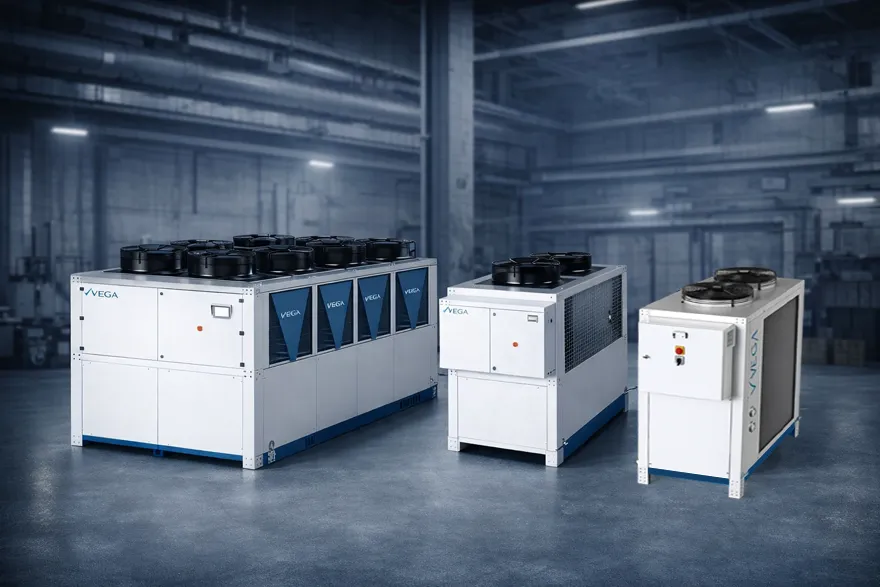
In modern manufacturing facilities, temperature control is critical not only for comfort, but also for product quality, process safety, energy efficiency, and equipment life. At this point, industrial chiller systems stand out as an indispensable cooling solution in many sectors. Especially in continuously operating production lines, maintaining precise temperature balance is of great importance for ensuring stable machine operation, preventing production losses, and reducing operating costs.
Chiller systems support production continuity by removing unwanted heat generated during the process in a controlled manner. Used across plastic injection, metalworking, food production, chemicals, pharmaceuticals, textiles, printing, laser cutting, CNC, and many other industrial applications, these systems provide significant advantages to businesses through high performance, long service life, and reliable operating principles.
In this guide, we will cover in detail what an industrial chiller is, how an industrial chiller works, where it is used, what should be considered during selection, and why the right chiller investment directly affects operational efficiency.
What Is an Industrial Chiller?
An industrial chiller is a central cooling system used to remove heat generated in process equipment, machines, or production lines. These systems typically cool a fluid such as water or a water-glycol mixture to a specified temperature and send this chilled fluid to process points to keep heat under control. Unlike standard HVAC solutions, industrial chiller systems are designed for much more demanding operating conditions. High ambient temperatures, long operating hours, dusty industrial environments, variable process loads, and precise temperature requirements are all taken into account in their design. For this reason, an industrial chiller is not simply a cooling unit, but a strategic process system that protects production quality.
Main Purpose of Industrial Chiller Systems
- Remove excess heat generated by machines and equipment
- Provide stable temperature control in the production process
- Protect product quality and process precision
- Reduce the risk of failure and extend equipment life
- Increase energy efficiency and lower operating costs
How Does an Industrial Chiller Work?
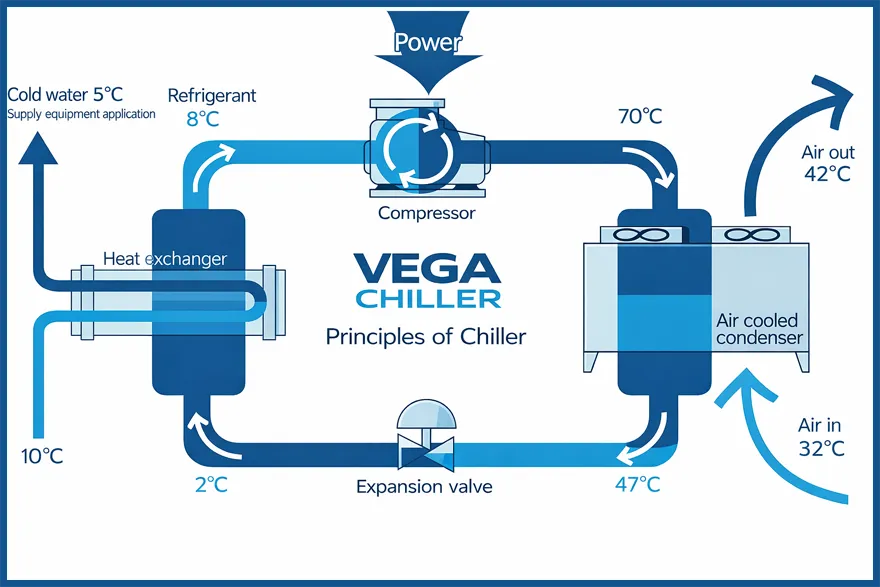
A chiller system basically operates according to the vapor-compression refrigeration cycle. The refrigerant circulating inside the system absorbs heat from one point and transfers it to another, thereby performing the cooling function. In industrial chiller systems, this process continues in a constant and controlled cycle.Chiller Operating Principle
The operating logic of an industrial chiller is based on four main components: the compressor, condenser, expansion valve, and evaporator. Each of these components is critical to system performance.1. Compressor
The compressor is considered the heart of the system. It compresses the low-pressure refrigerant gas coming from the evaporator, increasing both its pressure and temperature. This allows the refrigerant to reach a level where it can release its heat to the outside environment. Industrial chiller systems may use scroll, screw, or reciprocating compressors. Selecting the right compressor according to capacity and operating scenario directly affects system efficiency.2. Condenser
The high-temperature refrigerant gas coming from the compressor reaches the condenser section. Here, the heat carried by the refrigerant is transferred to the external environment. If the system is air-cooled, ambient air is used with the help of fans; if it is water-cooled, heat transfer takes place through water circulation on the condenser side. After releasing its heat, the refrigerant changes to liquid phase.3. Expansion Valve
The high-pressure liquid refrigerant leaving the condenser passes through the expansion valve, where it undergoes a sudden pressure drop. This pressure reduction also lowers the refrigerant temperature. As a result, the refrigerant becomes ready to absorb heat in the evaporator. The expansion valve also controls the amount of refrigerant entering the system, ensuring stable operation.4. Evaporator
As the cold, low-pressure refrigerant circulates through the evaporator, it absorbs heat from the process water. At this stage, the water is cooled while the refrigerant evaporates. The chilled water is then pumped to the process line, machines, or other heat-load points. In this way, the industrial chiller system maintains the required temperature in the production line.Main Components of Industrial Chiller Systems
For an industrial chiller system to operate successfully, not only the main refrigeration-cycle components but also the auxiliary equipment must be properly engineered.Main Components
- Compressor
- Evaporator
- Condenser
- Expansion valve
- Circulation pump
- Water tank or buffer tank
- Fan assembly
- Electrical panel and control system
- Safety equipment and sensors
The Importance of Control and Automation
Today’s advanced chiller systems do more than just provide cooling; they also monitor process temperature precisely, optimize capacity according to load changes, and protect system safety. Thanks to intelligent control panels, data such as temperature, pressure, flow, alarm history, and operating hours can be monitored in real time. This both simplifies maintenance planning and helps optimize energy consumption.What Are the Types of Industrial Chillers?
Industrial chiller systems are divided into different categories according to condenser design and application requirements. The right system type should be determined based on facility infrastructure, capacity needs, climate conditions, and energy targets.Air-Cooled Chiller
In air-cooled chiller systems, the heat on the condenser side is rejected to the outside environment by means of fans. Because they do not require water infrastructure and offer easier installation, they are widely preferred in industrial facilities. They provide advantages in rooftop, outdoor, and exterior applications.Advantages
- No cooling tower required
- No water consumption
- Faster installation and commissioning
- Simpler maintenance infrastructure
Disadvantages
- Efficiency may drop at high outdoor temperatures
- Acoustic measures may be required due to fan noise
Water-Cooled Chiller
In water-cooled chiller systems, water is used on the condenser side, and the system generally operates together with a cooling tower. They can offer higher efficiency in large-capacity applications. They are especially suitable for large industrial facilities and operations running continuously under load.Advantages
- May provide higher energy efficiency
- Advantageous in high-capacity applications
- Less affected by outdoor air temperature
Disadvantages
- Installation infrastructure is more complex
- Requires cooling tower and water quality management
- Maintenance demand is higher
Where Are Industrial Chillers Used?
Industrial chiller applications are extremely broad. Any sector in which heat is generated, precise temperature control is required, or machine performance depends on cooling may require chiller systems.Main Application Areas
- Plastic injection and extrusion lines
- Laser cutting and CNC machines
- Chemical and pharmaceutical production facilities
- Food and beverage production lines
- Metalworking and coating plants
- Textile machinery
- Printing and packaging industry
- Laboratory and process cooling applications
- Data centers and technical rooms
Its Role in Process Cooling
In many production processes, even a difference of a few degrees can directly affect product quality. For this reason, industrial chiller systems are used not only to cool machinery, but also to standardize process quality. They play a critical role especially in reducing cycle time in plastic injection molds, maintaining precision in laser machines, and keeping reaction temperatures stable in chemical production.What Should Be Considered When Selecting an Industrial Chiller?
Choosing the right chiller should not be based on capacity alone. Process load, environmental conditions, operating hours, future capacity increases, and service infrastructure should all be evaluated together during system design.Main Criteria for Proper Chiller Selection
- Required cooling capacity
- Entering and leaving water temperature values
- Ambient temperature and installation area
- Whether 24/7 operation is required
- Energy efficiency targets
- Redundancy requirements
- Service, maintenance, and spare parts accessibility
The Importance of Capacity Calculation
An undersized industrial chiller system cannot maintain the production line at the required temperature and will lead to performance loss. An oversized system, on the other hand, increases initial investment cost and may operate inefficiently under low load. For this reason, professional capacity calculation and project-specific chiller selection are of great importance.Advantages of Industrial Chiller Systems
A properly engineered industrial chiller provides more than just cooling; it also delivers operational safety, consistent quality, and long-term cost advantages.Main Advantages
- Provides uninterrupted and stable process temperature
- Extends machine and equipment life
- Improves production quality
- Reduces the risk of failures and downtime
- Enables cost control through energy efficiency
- Offers smarter operation through automation
Long-Term Operational Contribution
A chiller system is often one of the invisible yet critical infrastructures of an operation. However, a correctly selected and properly maintained system reduces unplanned production stoppages, keeps maintenance expenses under control, and lowers total cost of ownership. For this reason, an industrial chiller investment should be evaluated not as a short-term expense, but as a long-term productivity investment.Why Is Industrial Chiller Maintenance Important?
Even the highest-quality chiller system can suffer performance loss if not maintained regularly. Fouled condenser surfaces, insufficient flow, sensor errors, refrigerant shortage, or electrical connection problems can lead over time to reduced efficiency and system failures.Benefits of Regular Maintenance
- Optimizes energy consumption
- Reduces the risk of breakdowns
- Extends equipment life
- Reduces unexpected production stoppages
- Preserves cooling performance
Main Items to Check During Maintenance
- Refrigerant pressures and temperature values
- Fan and compressor operating condition
- Electrical panel and contactors
- Water circuit flow and filter cleaning
- Evaporator and condenser surface cleaning
- Alarm records and sensor accuracy