What Determines Chiller Prices?
One of the main questions users ask when researching
chiller prices is why there can be significant price differences between different units. In reality,
chiller prices are determined not only by the size of the unit, but also by factors such as capacity, compressor type, energy efficiency, automation level, cooling type, component quality, and project-specific engineering details.
Especially in chiller systems used in industrial facilities, price should not be evaluated like a standard product label. This is because every facility has different process requirements, operating temperatures, ambient conditions, and usage intensity. For this reason,
industrial chiller prices are often calculated on a project-specific basis.
In this guide, we will examine in detail
what affects chiller prices, the differences between
air-cooled chiller prices and other systems, what should be considered when requesting a quotation, and what long-term risks may arise from choosing a low-cost chiller.
What Is a Chiller Price and Why Is It Not Fixed?
A
chiller price is the total investment cost determined according to the technical specifications, capacity, and intended use of the cooling system. However, the important point to note here is that the price of a chiller unit should often not be evaluated on its own. In addition to the unit cost itself, the installation structure, control system, pump group, tank, electrical infrastructure, and service support are also part of the total investment cost.
For this reason, some general prices seen online can be misleading. Even between two chiller units that appear to have the same capacity, there may be serious price differences. The reasons for this include the compressor brand used, heat exchanger quality, control panel level, energy efficiency, brand reliability, and engineering quality.
Why Do Chiller Prices Vary?
- Every facility has different requirements
- As capacity increases, unit size and cost also increase
- The brands of components used affect the price
- High-efficiency units are priced differently
- Project-specific automation and control systems change the cost
- The quality of service and after-sales support affects the overall value
Main Factors That Affect Chiller Prices
When evaluating a
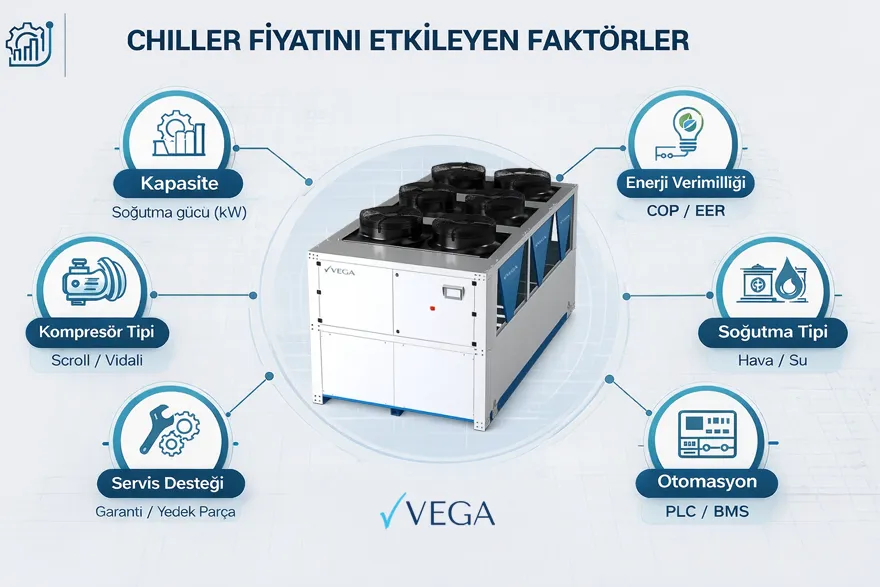
chiller price, the first thing to consider is which technical specifications the unit offers. The following factors are the most decisive elements affecting price.
1. Cooling Capacity
The most important factor affecting chiller prices is capacity. As cooling capacity increases, compressor power, heat exchanger dimensions, fan assembly, electrical equipment, and the overall cabinet structure also grow. Naturally, this leads to higher cost.
It is entirely normal for there to be a price difference between a low-capacity system and a high-capacity industrial chiller. However, as capacity increases, not only does the unit price rise, but the complexity of the system design also increases.
2. Air-Cooled or Water-Cooled?
Air-cooled chiller prices differ from the prices of water-cooled systems. Air-cooled chillers are generally easier to install and do not require an additional cooling tower. For this reason, they may offer an advantage in terms of total investment cost in some projects.
In water-cooled systems, in addition to the unit itself, a tower, pumps, and water management infrastructure may also be required. Therefore, it is necessary to evaluate not only the unit price, but the total system cost as a whole.
3. Compressor Type
The type of compressor used in chiller systems has a major effect on price. There are both performance and cost differences between scroll, reciprocating, and screw compressors. In large-capacity industrial chiller systems, more advanced and higher-cost compressor solutions are generally preferred.
4. Energy Efficiency
Some units that appear to have a lower initial investment cost may become more expensive in the long run due to high energy consumption. For this reason, when evaluating a
chiller price, attention should be paid not only to the purchase price, but also to the unit’s energy efficiency.
Chillers with high EER or COP values, inverter support, or advanced control systems may be priced differently at the beginning; however, they can reduce total cost over time by delivering energy savings during operation.
5. Quality of Components Used
The quality of the heat exchanger, fans, electrical equipment, control panel, sensors, and piping used in a chiller unit directly affects the price. Units built with high-quality components are more reliable, longer-lasting, and more stable in operation.
6. Automation and Control System
A system with a basic control panel will not be priced at the same level as a chiller system offering advanced automation, remote monitoring, alarm tracking, and precise temperature control. Especially in facilities where process safety is important, advanced control infrastructure offers a significant advantage.
7. Brand and Service Support
The price of a chiller is not limited to the unit itself. The brand’s engineering quality, technical consultancy, spare parts accessibility, and after-sales service strength are also important parts of the price. A lower-cost system with weak service support may create much higher costs for the operation in the event of a failure.
What Should Be Considered When Requesting a Quote for Industrial Chiller Prices?
Many users request a quote simply by asking, “What is the chiller price?” However, in order to receive the right quotation, technical data must be shared clearly. Otherwise, the quoted price may not fully match the actual requirement.
Information That Should Be Defined Before Requesting a Quote
- Required cooling capacity
- Entering and leaving water temperatures
- Ambient temperature at the installation site
- Whether the unit will be used indoors or outdoors
- Process type and operating hours
- Whether a pump and tank are required
- Whether a redundant system is needed
Without this information, the quoted prices usually remain at a general-information level. In a professional quotation process, the chiller system should be evaluated according to the real operating conditions of the facility.
Is a Low Chiller Price Always an Advantage?
In the short term, a low-priced unit may seem advantageous. However, when evaluating
chiller prices, the total cost of ownership must be taken into account. A unit with a low initial investment cost may become much more expensive later due to high electricity consumption, frequent breakdowns, spare parts issues, and production losses.
Possible Risks of Choosing a Low-Cost Chiller
- Insufficient cooling performance
- High energy consumption
- Shorter equipment life
- More frequent service needs
- Process shutdowns and production losses
- Delays in spare parts supply
For this reason, the right approach is not to look for the “cheapest chiller,” but to select the “most suitable and most advantageous chiller in the long term.”
Why Are Air-Cooled Chiller Prices Searched So Often?
Searches related to
air-cooled chiller prices are especially common because of their practical installation advantages. Air-cooled systems are often the first choice in many projects because they do not require a cooling tower, do not consume water, and allow for compact installation.
However, in these systems as well, price varies according to capacity, fan design, condenser quality, outdoor operating conditions, and the control technology used. Therefore, even in air-cooled systems, project-specific solution logic is more relevant than a fixed price.
The Relationship Between Chiller Prices and Energy Efficiency
Focusing only on the purchase cost of a chiller can be misleading. This is because energy consumption represents a very large portion of the total cost of chiller systems. A more efficient system may appear slightly more expensive at the investment stage, but it can provide savings throughout its operating life.
Why Is Energy Efficiency Important?
- It reduces electricity consumption
- It lowers long-term operating costs
- It provides more stable temperature control
- It adapts better to system load changes
- It contributes to sustainability goals
For this reason, in a professional price evaluation, not only the initial purchase cost but also the annual energy expense should be considered.
Common Mistakes in Chiller Price Research
Many businesses focus only on the price tag when researching prices. However, to select the right system, it is necessary to understand the technical content behind the price.
Most Common Mistakes
- Comparing only the lowest price
- Requesting a quote without calculating capacity
- Ignoring energy efficiency
- Not evaluating service support
- Overlooking spare parts accessibility
- Requesting a general price instead of a project-specific solution
Why Should You Request a Quote from Vega Chiller?
Vega Chiller operates not with the mindset of a brand that simply sells equipment, but with an approach based on project-specific analysis, correct capacity determination, efficient system design, and strong after-sales support. In this way, customers receive not just a price, but a real solution tailored to their needs.
Every facility has a different load profile, operating condition, and process characteristic. For this reason, the correct
chiller price can only be determined through proper engineering evaluation. Vega Chiller offers professional solutions that consider both investment cost and long-term operating advantages together.
What Should Be the Focus When Evaluating Chiller Prices?
Chiller prices are not simply a matter of comparing numbers. A real evaluation should be made by considering capacity, system type, component quality, energy efficiency, automation level, and after-sales support together.
If you want to receive the right
chiller price quotation for your facility, you should focus not only on the initial cost, but also on the system’s long-term performance and the total value it will provide. As Vega Chiller, we identify the most suitable industrial cooling solution for your business and offer reliable, efficient, and sustainable chiller systems.