



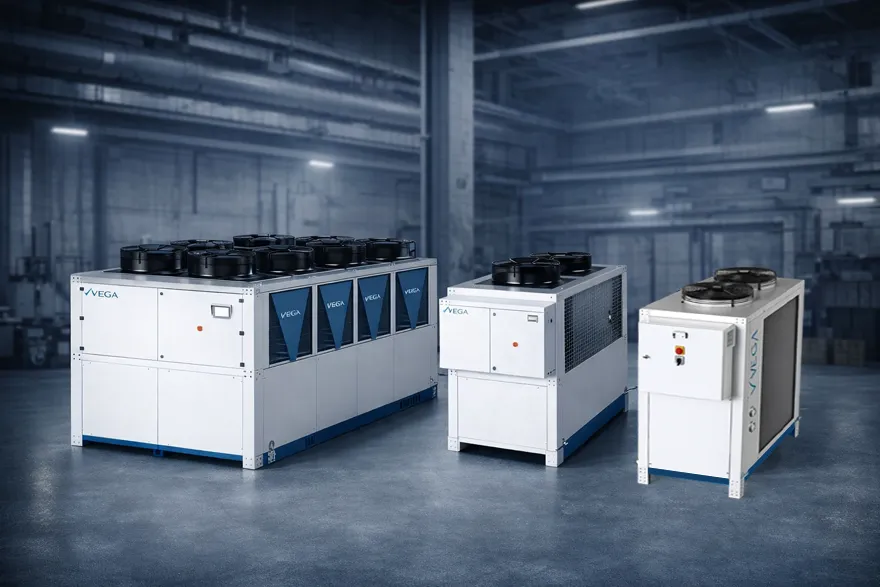
From industrial facilities to commercial buildings, from plastic injection lines to precision process applications, temperature control is a critical requirement in many fields. At this point, one of the most frequently encountered concepts is the chiller system. Especially in Google searches for “what does chiller mean,” users typically expect not only to learn the Turkish meaning of the term, but also to clearly understand what the system does, how it works, and where it is used.
In its simplest definition, a chiller is a cooling unit that lowers a fluid to a specific temperature and enables that chilled fluid to be used in another system. However, the concept of a chiller carries a much broader technical meaning than can be explained by the phrase “cooling device” alone. These systems play a direct role in energy efficiency, process safety, product quality, equipment life, and operational continuity.
In this article, we will examine in detail the most important questions, starting with the Turkish meaning of the word chiller: what is a chiller, how does a chiller work, what are its main components, where is it used, and how should the right chiller be selected. At the same time, we will approach the subject not only from a general definitional perspective, but also from a corporate engineering standpoint, explaining why professional evaluation is essential in industrial applications.
What Does Chiller Mean? The Turkish Meaning of the Word “Chiller”
The word “chiller” is of English origin and can generally be translated into Turkish as cooler or water chiller unit. In industrial use, however, the term usually carries a more specific meaning: a central cooling unit that chills water or a similar fluid and uses that chilled fluid in a process, machine, production line, or HVAC system.
Therefore, the most accurate answer to the question “what does chiller mean” is not simply to provide its dictionary equivalent, but also to explain the function and intended use of the system. In technical terminology, a chiller refers to a system that does not transfer cooling directly to ambient air, but instead cools a fluid first and then provides controlled cooling through that fluid.
In this respect, chiller systems differ from conventional standalone cooling devices by offering more controlled, higher-capacity solutions that generally require a more professional engineering approach.
What Is a Chiller?
The technical answer to the question what is a chiller is as follows: A chiller is a mechanical cooling system that lowers the temperature of a liquid by means of a refrigeration cycle and provides heat transfer by circulating that chilled liquid through a system.
These systems typically use water or a water-glycol mixture. The chilled fluid is sent to process equipment, molds, heat exchangers, fan coil systems, or various industrial points. There, it absorbs heat from the environment or equipment and carries it back to the chiller system, thereby completing the cycle.
Chiller systems can be manufactured in different sizes and configurations depending on the intended application. Some systems are preferred for building air conditioning, while others are used entirely to maintain temperature stability in production processes. For this reason, a chiller is not merely a piece of equipment that produces chilled water, but also a strategic infrastructure element that directly affects operating performance.
What Do Chiller Systems Do?
The primary function of chiller systems is to remove unwanted heat from an environment or a piece of equipment. In many industrial applications, heat generated during the process can lead to quality losses, reduced efficiency, equipment failures, and production downtime if it is not properly controlled. A chiller eliminates this risk by providing controlled and continuous cooling.
Its main functions include:
- Removing heat generated by machinery and equipment
- Keeping process temperature within defined limits
- Preserving product quality
- Providing stable operating conditions in precision manufacturing processes
- Supporting centralized cooling in HVAC systems
- Preventing equipment overheating
- Supporting energy efficiency and operational continuity
In particular, industrial chiller systems are not simply auxiliary equipment in facilities with continuous production; they are an integral part of process safety. For this reason, selecting the right capacity and the right design is critically important.
How Does a Chiller Work?
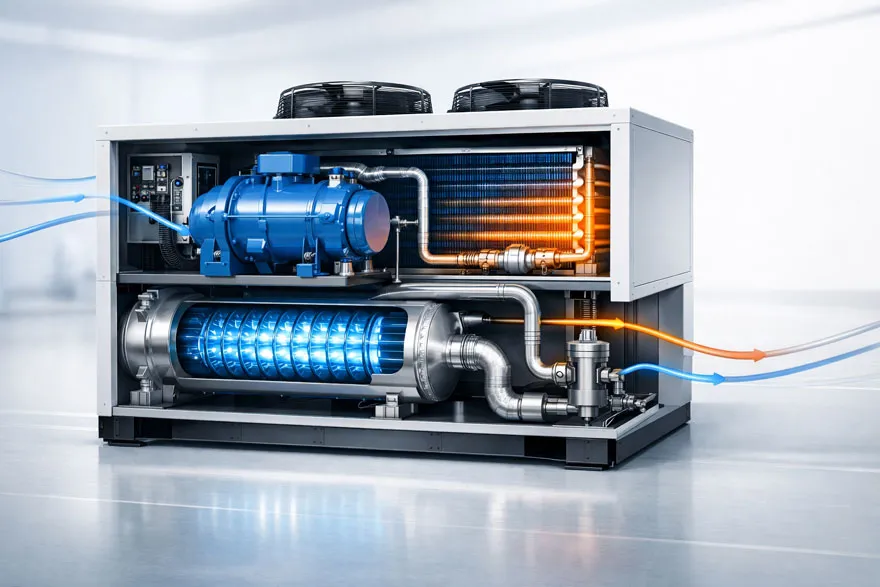
The chiller operating principle is fundamentally based on the vapor-compression refrigeration cycle. The system uses the pressure and temperature changes of a refrigerant to absorb heat from one side and reject it to the outside. In this process, the cooled side is generally the water circuit.
To explain the operating logic simply, the chiller first removes heat from the fluid, then transfers that heat out of the system. In this way, the water line is maintained at the desired low temperature, and process cooling continues.
Main Stages of the Refrigeration Cycle
- Evaporator stage: As the refrigerant evaporates at low pressure, it absorbs heat from the water circuit.
- Compressor stage: The vaporized refrigerant is compressed by the compressor, increasing its pressure and temperature.
- Condenser stage: The high-temperature refrigerant releases heat to the outside environment and condenses into a liquid.
- Expansion device stage: The refrigerant, whose pressure has been reduced, re-enters the evaporator and the cycle begins again.
Depending on the system design, this cycle operates continuously by rejecting heat through air or water. The main objective is to provide stable temperature control in the circuit that needs to be cooled.
Main Components of a Chiller System
The performance of a chiller unit depends on the correct selection of its main components and their ability to operate in harmony with one another. For this reason, understanding the basic parts of the system is important both for understanding its operating logic and for making the right product selection.
Compressor
The compressor is considered the heart of the chiller system. It compresses the low-pressure refrigerant coming from the evaporator, raising it to high pressure and high temperature. This allows the refrigerant to reach the conditions required to reject heat in the condenser.
The type of compressor can directly affect capacity, efficiency, noise level, and application area. Different compressor technologies such as scroll, screw, and centrifugal are preferred depending on the operating scenario.
Evaporator
The evaporator is the section where the cooling effect actually takes place. As the refrigerant evaporates here, it absorbs heat from the process water. As a result, the temperature of the water drops and the chilled fluid required by the system is obtained.
Especially in process cooling system applications, evaporator performance is extremely critical in terms of temperature stability, because product quality often depends on that stability.
Condenser
The function of the condenser is to reject the heat carried by the high-temperature refrigerant coming from the compressor to the outside environment. Once the heat rejection is completed, the refrigerant condenses and returns to liquid form.
The operating method of the condenser varies depending on whether the system is an air-cooled chiller or a water-cooled chiller. In air-cooled systems, heat is rejected directly to ambient air. In water-cooled systems, this process is carried out through a water circuit and, in most cases, a cooling tower.
Expansion Device
The expansion device reduces the pressure of the liquid refrigerant and ensures that it enters the evaporator under suitable conditions. Thanks to this component, the refrigerant returns to a low-temperature state and becomes ready to absorb heat again.
Although it appears to be a small part, it plays a highly critical role in the balanced operation of the cycle. If it is not properly controlled, system performance may decline and energy consumption may increase.
Differences Between Air-Cooled and Water-Cooled Chillers
Chiller systems are generally divided into two main categories according to the method used to reject heat to the external environment: air-cooled chillers and water-cooled chillers. The type to be preferred depends on facility infrastructure, climate conditions, energy strategy, maintenance capabilities, and project requirements.
Air-Cooled Chillers
In air-cooled chiller systems, heat is rejected with the help of air passing through the condenser. Fans move air across the condenser coils to provide cooling.
- Installation is relatively more practical
- No cooling tower is required
- There is no water consumption
- They may be more affected by outdoor conditions
- They offer compact solutions suitable for many projects
Air-cooled systems are especially preferred in standalone facilities, medium-scale production areas, and projects where ease of on-site installation is required.
Water-Cooled Chillers
In water-cooled chiller systems, heat is removed through condenser water. These systems generally operate together with a cooling tower and are preferred in larger-capacity projects.
- They can be efficient in high-capacity applications
- They may be less affected by outdoor air temperature
- They require additional infrastructure
- Installation and maintenance planning may be more comprehensive
- They can provide long-term operating advantages in large facilities
The key point here is that no single system type is the best solution for every project. The actual requirement should be determined according to the load profile, operating hours, environmental conditions, and operational priorities. This is exactly where a corporate engineering approach becomes essential.
Where Are Chiller Systems Used in Industry?
Chiller systems have a very wide range of applications. Controlled cooling is now a fundamental requirement not only in large industrial facilities, but also in commercial buildings and precision manufacturing processes.
Plastic Injection
In plastic injection processes, mold temperature control is critical for cycle time and product quality. Insufficient or unstable cooling can cause deformation, surface defects, dimensional inconsistency, and efficiency losses. For this reason, chiller systems are among the most important auxiliary systems in plastic injection plants.
HVAC and Building Air Conditioning
Chiller systems are used for centralized cooling in commercial buildings, hospitals, hotels, offices, and large living spaces. The objective here is to provide indoor comfort and controlled air conditioning across large volumes.
Process Cooling
In production lines requiring a process cooling system, temperature must be maintained within specific limits. Reactors, laser systems, machine lines, printing systems, and various production equipment can all be evaluated within this scope.
Food and Beverage Industry
In food production, temperature control is important for both quality and hygiene. In fermentation, filling, processing, and storage processes, controlled cooling plays a major role in maintaining product standards.
Chemical Industry
Temperature management is essential for carrying out chemical reactions safely and under control. Chiller systems help keep reaction heat under control and improve process safety.
Pharmaceutical and Laboratory Applications
In pharmaceutical manufacturing and laboratory environments, precise temperature control is required. Chiller systems are especially important in applications where stable conditions must be maintained.
Manufacturing Facilities
In metalworking, CNC lines, packaging, textiles, electronics, and many other production areas, chillers are used to prevent equipment overheating and ensure process continuity.
Why Is It Critically Important in Industry?
Although chiller systems may appear to be merely auxiliary equipment for many businesses, they are in fact among the key systems that directly affect production safety. When temperature control is disrupted, the impact is felt not only in energy consumption, but also in product quality, capacity utilization, maintenance costs, and delivery times.
The main reasons why chiller systems are critically important in industry are as follows:
- They protect production quality
- They support the service life of machinery and equipment
- They reduce the risk of unplanned downtime
- They provide process stability
- They contribute to energy management
- They improve operational efficiency
For this reason, chiller selection and system design should not be based solely on catalog data. Especially in industrial projects, analyzing the real operating scenario is extremely important for long-term operational success.
Key Criteria to Consider When Selecting a Chiller
Choosing the right chiller does not simply mean purchasing a unit; it means establishing an efficient, sustainable, and reliable cooling infrastructure suited to the needs of the facility. For this reason, the following criteria should always be taken into account during the selection process.
Capacity Requirement
The first and most important criterion is how much cooling capacity the system requires. Insufficient capacity leads to process problems, while oversized capacity may create disadvantages in terms of both initial investment and operating efficiency.
Application Type
Will the chiller be used for an HVAC project, or for process cooling? This distinction is highly important because the required temperature sensitivity, load variability, and operating regime vary depending on the application.
Energy Efficiency
Energy consumption accounts for a large share of the total operating cost of chiller systems. For this reason, choosing high-efficiency systems provides significant long-term advantages. Energy performance becomes even more critical in facilities that operate continuously.
Ambient Conditions
The climate of the installation location, outdoor temperature, ventilation conditions, water quality, and site layout all affect the selection decision. For example, in extremely hot outdoor conditions, system behavior should be evaluated differently and the project should be optimized accordingly.
Ease of Maintenance and Service
Systems that are difficult to maintain can turn into an operational burden over time. Accessible component design, service support, and spare parts availability are important considerations in the selection process.
Operating Cost
In addition to initial investment cost, the total cost of ownership should also be evaluated. Electricity consumption, maintenance costs, water usage, service requirements, and system lifespan should all be considered together.
Future Growth and Flexibility
In some facilities, production capacity may increase over time. For this reason, having a modular system or planning the system in a way that allows future expansion can provide an important advantage.
Frequently Asked Questions
What does chiller mean?
In Turkish, chiller generally means a cooler or water chiller unit. Technically, it is a mechanical cooling unit that chills a fluid and uses it in another system.
Is a chiller the same as an air conditioner?
No. While air conditioning generally refers to systems that condition ambient air directly, a chiller typically cools water or another fluid first, and then that cooling is used through other systems. In some large HVAC projects, the chiller serves as part of the central system.
Where are chillers used?
They are used in plastic injection, HVAC, food, chemical, pharmaceutical, production lines, laboratories, and various process cooling applications.
Which is better: an air-cooled chiller or a water-cooled chiller?
There is no single correct answer. The right choice depends on cooling capacity requirements, site conditions, water availability, energy strategy, and maintenance infrastructure.
What is the most important criterion when selecting a chiller?
The most critical factor is the correct calculation of the actual cooling load. In addition, energy efficiency, application type, ambient conditions, and operating cost should all be evaluated together.
At first glance, the question “what does chiller mean” may appear to be a simple request for a definition, but in reality it opens the door to one of the core concepts of the industrial cooling world. A chiller is a system that cools a fluid and uses it to provide controlled cooling for processes, machines, or buildings, and it requires a high-level engineering approach.
Today, chiller systems have become indispensable in many sectors in terms of production quality, energy efficiency, equipment safety, and operational continuity. However, the same system is not the right solution for every application. Capacity calculation, environmental conditions, usage scenario, and operational expectations should all be assessed together.
For this reason, professional chiller selection should not be handled solely through technical catalog comparison, but through an expert perspective that evaluates the application as a whole. A properly engineered chiller solution does not only meet today’s requirements; it also contributes to the long-term efficiency and safety of the operation. For businesses that think on a corporate scale, this approach is one of the cornerstones of sustainable performance.