Applications
Chiller Cooling for Printing Machines: A Professional Application Guide to Thermal Control in the Printing and Packaging Industry
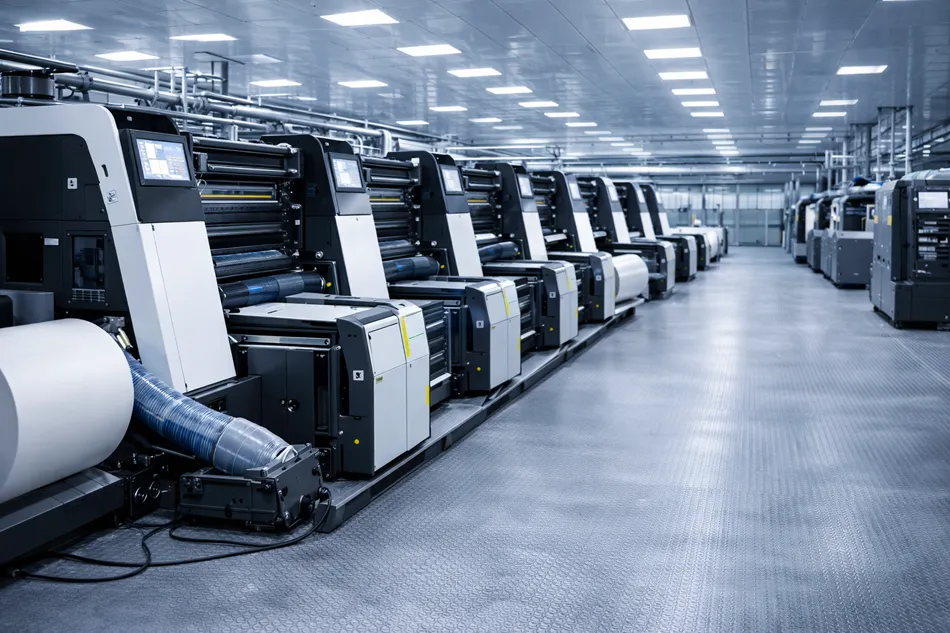
In the printing and packaging industry, quality is determined not only by accurate color management, printing pressure, and operator expertise, but also by thermal stability. Offset, flexographic, rotogravure, screen printing, and industrial digital printing lines generate significant heat due to high-speed rollers, UV/IR drying systems, motor drives, and ink circulation units. When this heat is not properly controlled, ink viscosity changes, print registration errors increase, drying becomes unstable, and scrap rates rise. For this reason, chiller-based printing machine cooling solutions are a strategic infrastructure for maintaining both production continuity and print quality.
VEGA Chiller provides stable temperature management for printing machines and auxiliary processes, aiming to ensure color consistency, longer machine life, higher productivity, and controlled energy consumption at the same time. In this guide, we examine in detail the role of chillers in printing machine cooling applications, the correct capacity sizing and hydronic design criteria, control strategies that improve efficiency, and the maintenance practices required for reliable operation.
Chiller Cooling for Printing Machines: Why Is a Chiller Essential for Printing Machine Cooling?
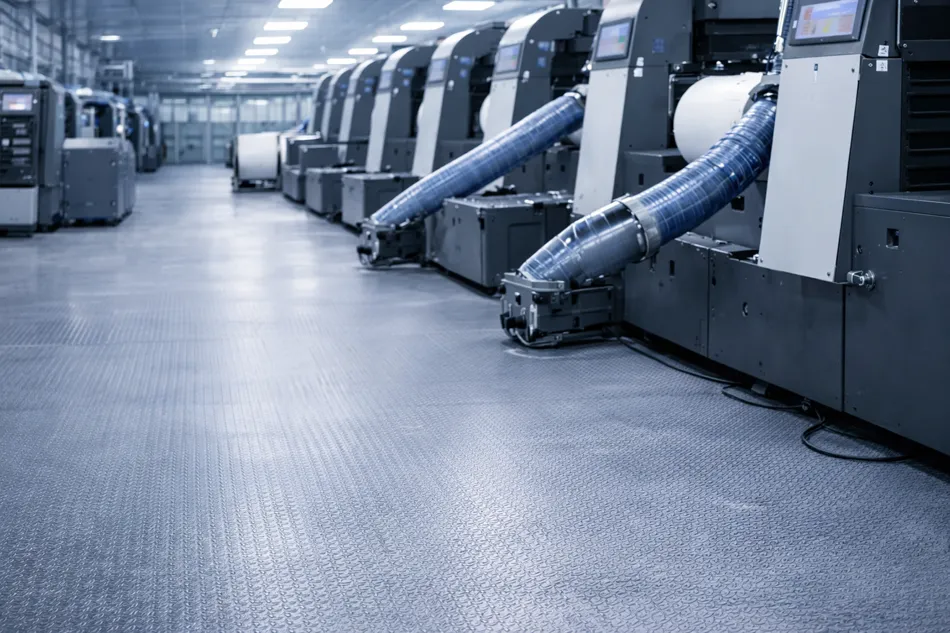
In printing lines, heat generation comes from multiple sources: mechanical friction, motor/drive systems, UV/IR dryers, process circuits, and ambient conditions. When heat is not kept under control, printing parameters continuously drift, resulting in a production process that cannot maintain stable settings. Chiller systems remove heat from the process by circulating chilled water or a water-glycol mixture and keep critical components within the target temperature range.
- Color stability improves; ΔE deviations are reduced
- Ink viscosity is controlled; flooding and fluctuations decrease
- Register and print alignment remain more stable
- High-speed production becomes more reliable
- Waste and downtime are reduced; production continuity improves
Where Is Chiller-Based Printing Machine Cooling Used?
1) Ink Circuit and Viscosity Control
Especially in flexographic and rotogravure lines, ink temperature directly affects viscosity and transfer characteristics. As temperature rises, viscosity may decrease, which can lead to problems such as unstable print density and ink flooding. With chiller integration, the ink circuit is maintained at a stable temperature, thereby strengthening color repeatability.
2) Roller and Cylinder Cooling
Printing rollers (anilox, impression roller, transfer roller, etc.) heat up due to friction and process load. Even small fluctuations in roller temperature can affect ink transfer. Chiller-assisted roller cooling provides thermal stability at the contact surface and helps preserve print quality, especially during long production runs.
3) Process Stabilization After UV/IR Drying
In lines using UV or IR drying, temperatures rise in and around the drying section. This temperature increase can cause dimensional changes in film and paper, adhesion problems, and defects in lamination or coating stages. The chiller system stabilizes process temperatures in critical areas and ensures consistent production after drying.
4) Hydraulic Units, Vacuum Systems, and Auxiliary Equipment
In large printing lines, vacuum pumps, hydraulic power units, and electrical panels generate heat. Overheating of this equipment increases the risk of failure and may cause production stoppages. A cooling infrastructure supported by an industrial chiller contributes to the stable operation of auxiliary equipment.
Application Note: “Single Chiller” or “Central System”?
For a single printing line, a machine-specific chiller solution may be appropriate. In multi-line facilities, however, a central chiller system may offer advantages in terms of maintenance management, redundancy configuration, and capacity sharing. The right choice should be based on production scale and load profile.
Chiller Selection in Printing Lines: Capacity, Flow Rate, and ΔT Criteria
Why Is Chiller Capacity Calculation Critical?
In printing machines, the cooling load varies depending on machine speed, ink type, drying technology (UV/IR), ambient temperature, film/paper type, and the number of cooling circuits. If proper chiller capacity sizing is not performed, two major problems arise: insufficient capacity leads to quality issues and downtime, while oversized capacity causes unnecessary investment and poor part-load efficiency. In VEGA Chiller projects, capacity selection is evaluated together with actual site data, operating scenarios, and future expansion margin.
Flow Management: Proper Hydronic Design for Stable Cooling
One of the most common field issues is that even when chiller capacity is correct, insufficient flow fails to reach the circuits. Pipe diameters, pump selection, manifold distribution, and pressure losses must be calculated properly. Low flow reduces heat transfer; excessively high flow may create unnecessary pump energy consumption and control difficulties.
ΔT Optimization and Process Stability
ΔT is the temperature difference between supply and return water. In printing applications, the objective is to optimize ΔT according to process requirements in order to improve both quality stability and energy efficiency. Very low ΔT increases pump consumption; very high ΔT may cause process temperature fluctuations. Correct ΔT is one of the key parameters that keeps the process “in register,” especially during long runs.
Energy Efficiency: Methods to Reduce Chiller Operating Cost in Printing Plants
Energy cost represents a significant portion of total operating expenses in printing plants. To improve energy efficiency in chiller systems:
- Select a model with capacity matched to the load profile and high part-load efficiency
- Use inverter-controlled pumps and fans (VFD)
- Optimize setpoints and avoid unnecessarily low temperature targets
- Keep heat exchanger surfaces clean to reduce heat transfer losses
- Use automation for circuit-based control and operating time management
These measures reduce energy consumption without compromising production quality and optimize total cost of ownership.
Installation and Integration: Reducing Error Risk in Printing Machine Cooling
Installation quality determines long-term performance in chiller-based printing machine cooling systems. Incorrect piping, insufficient insulation, air entrapment, lack of filtration, and poor sensor placement can all impair system stability and increase failure risk.
Filtration and Water Quality
Sediment and particle buildup may cause blockage in valves and heat exchangers. This reduces flow rate and degrades heat transfer performance. Filtration and proper water treatment are critical requirements for stable system operation.
Automation and Remote Monitoring
Downtime costs are high in printing lines. For this reason, the chiller’s alarm management, monitoring of temperature-flow-pressure values, and remote access capabilities are especially important. With trend analysis, potential problems can be detected before they occur, enabling planned intervention.
Maintenance and Service: Chiller Continuity in Printing Plants
In chiller systems without regular maintenance, performance degradation and increased energy consumption are inevitable. In addition, since even a small temperature fluctuation in the printing process can affect quality, maintenance discipline is critically important.
Scope of Periodic Maintenance
- Condenser/evaporator cleaning and inspection
- Refrigerant pressure checks, leak testing, and charge verification
- Pumps, fans, and electrical panel measurements
- Sensor calibration and control panel testing
- Performance verification through flow rate and ΔT measurements
VEGA Chiller’s Engineering Approach to Printing Machine Cooling
VEGA Chiller approaches chiller systems in the printing and packaging industry not as standalone equipment, but as an integrated system serving the production line’s quality and continuity objectives. Site survey, load analysis, hydronic design, commissioning, and maintenance processes are planned holistically. The goal is to standardize print quality through temperature stability while reducing operating costs.
Site Survey, Design, and Commissioning
The correct chiller system is planned by analyzing line configuration, ink circuits, roller cooling requirements, the drying system, and ambient conditions. During commissioning, flow rate, setpoint stability, and alarm scenarios are tested to validate system performance.
Chiller-Based Printing Machine Cooling Is a Critical Investment That Standardizes Quality
In printing and packaging production, temperature control directly influences color consistency, register accuracy, ink transfer, and surface quality. A properly selected and correctly engineered chiller-based printing machine cooling system provides process stability, low waste, and sustainable energy efficiency. VEGA Chiller delivers reliable, efficient, and long-life chiller solutions for the printing sector with its engineering-focused approach.