Applications
Chiller Cooling for Food and Beverage Applications: A Comprehensive Application Guide to Industrial Cooling Systems in Food Processing
In the food and beverage industry, the key to competitiveness lies in the ability to ensure product safety, consistent quality, shelf life, and control of energy costs. The common denominator across all four is temperature management. From dairy products to soft drinks, from beer production to chocolate and confectionery, and from sauce and oil lines to cold-filling processes, temperature plays a decisive role in product microbiological safety, flavor profile, viscosity, stability, and production efficiency.
For this reason, chiller-based food and beverage cooling systems are not merely auxiliary equipment in food processing plants; they are a critical infrastructure component, just as essential as the process control panel itself. A properly engineered industrial chiller system maintains process temperatures within the target range, reduces production fluctuations, minimizes product loss, and optimizes total cost of ownership. VEGA Chiller aims to deliver long-term and sustainable cooling infrastructure for the food and beverage industry through hygienic design principles, stable temperature control, glycol-based solutions, energy efficiency, and a planned maintenance approach.
In this comprehensive guide, we examine at a professional level the application areas of chillers in food and beverage processes, the critical parameters for proper chiller selection, when glycol systems are required, the methods that improve energy efficiency, and the maintenance strategies that support reliable operation.
Chiller Cooling for Food and Beverage Applications: Why Chiller Cooling Is a Critical Application in the Food and Beverage Industry
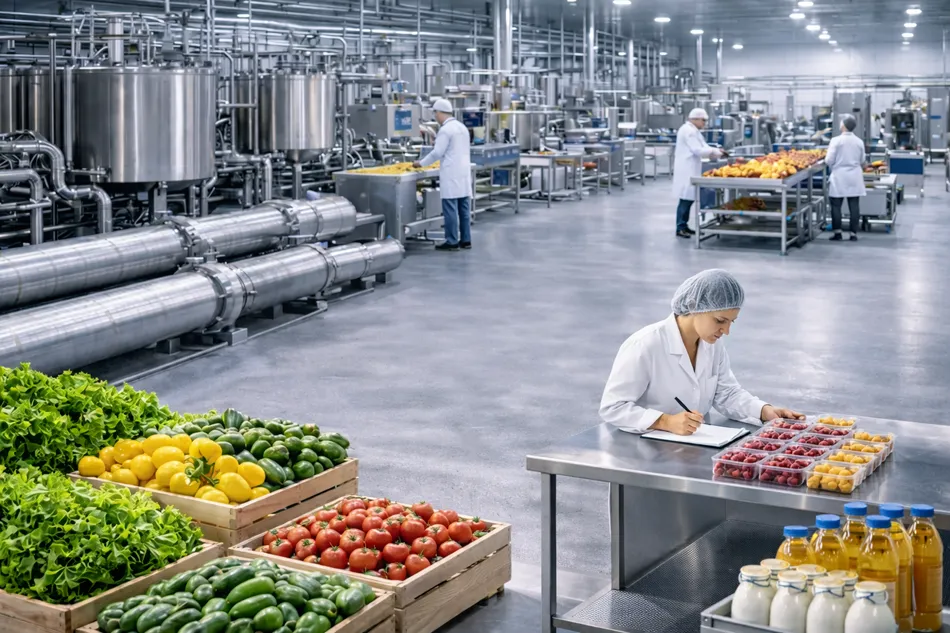
In food processing plants, temperature control is not only about cooling; it is also directly related to food safety (HACCP), product standardization, and process continuity.
In facilities with poor temperature control, microbial growth risk increases, product consistency deteriorates, line stoppages become more frequent, and quality complaints rise.
In addition, systems operating at unnecessarily low setpoints may cause excessive energy consumption.
- Food safety: Accurate temperature control during pasteurization and cooling stages
- Quality consistency: Maintaining flavor, texture, foam, color, and stability parameters
- Shelf life: Slowing down spoilage reactions
- Energy efficiency: Lower operating cost with COP/EER and part-load optimization
Chiller Applications in Food and Beverage Processing
Chiller systems in food production rarely serve only one point; they usually supply cooling to multiple critical areas of the plant.
Application requirements depend on product type, production capacity, process flow, and target temperatures.
1) Dairy Processing — Rapid Cooling After Pasteurization
One of the most critical steps in dairy plants is rapid and controlled cooling after heat treatment.
If the product leaving pasteurization or UHT is not cooled quickly, microbiological risk increases and product quality becomes unstable.
The chiller supplies chilled water or glycol through plate or shell-and-tube heat exchangers.
- Raw milk reception tank pre-cooling
- Post-pasteurization product cooling
- Yogurt / ayran mixing tank temperature control
- Whey process temperature management
2) Beer and Fermented Beverages — Fermentation Tank Cooling
Fermentation is a temperature-sensitive biochemical process.
In beer production, fermentation temperature directly affects yeast activity, aroma profile, and final product quality.
Fermentation tanks are usually cooled with a glycol loop.
In this case, the chiller operates as a glycol chiller, supplying low-temperature fluid to tank jackets to maintain stable fermentation conditions.
Stable temperature ensures batch-to-batch consistency and prevents unwanted flavor deviations.
3) Soft Drinks and Cold Filling Lines
Temperature affects carbonation stability, filling performance, and packaging quality.
In cold filling applications, maintaining product temperature within the target range reduces foaming and filling errors.
The chiller supplies chilled water / glycol to:
• line heat exchangers
• product tanks
• process equipment
4) Chocolate and Confectionery — Tempering and Process Cooling
Tempering is a critical step that determines crystal structure.
Even small temperature deviations may cause:
• fat bloom
• dull surface
• brittleness loss
• visual defects
Chiller cooling ensures stable temperature in tempering machines and cooling tunnels.
5) Sauce, Oil and Syrup Lines — Viscosity Control
Sauces, syrups, and oil-based products are temperature-dependent.
Too hot → viscosity drops
Too cold → pumping becomes difficult
Cooling jackets, heat exchangers, and stabilization steps
often require chilled water or glycol.
6) Bakery and Dough Processes — Mixer Jacket Cooling
Dough temperature determines fermentation behavior and structure.
High-speed mixers generate heat.
Cooling jackets supplied by chiller water / glycol
keep dough temperature within limits.
7) Packaging and Labeling Equipment Cooling
Some packaging lines require temperature-controlled adhesives,
and high-speed equipment generates heat.
Chiller cooling improves equipment stability.
Application Note: Process Cooling vs Storage Cooling
Chiller systems are mainly used for process cooling,
while cold rooms use refrigeration evaporators.
Both systems may coexist but have different design criteria.
When Is a Glycol Chiller Required?
Water is not always sufficient.
Glycol is used when:
• low temperature required
• freezing risk
• outdoor installation
• fermentation cooling
Higher glycol ratio → higher viscosity → lower heat transfer
Fluid selection must match pump, piping, and ΔT design.
Chiller Selection Criteria
Capacity Calculation
Food plants have dynamic loads.
Correct sizing must consider:
• simultaneous loads
• peak scenarios
• ambient conditions
• exchanger efficiency
• future expansion
Wrong sizing →
undersizing → quality risk
oversizing → low efficiency
Hygiene and Food Compatibility
Even if the chiller does not touch product,
design must follow hygienic principles.
Important:
• leak prevention
• cleanable layout
• proper insulation
• corrosion resistance
Control and Automation
Stable setpoint = stable product.
Monitoring and remote control
prevent temperature deviations.
VEGA Chiller systems are designed
to maintain stable process temperature windows.
Energy Efficiency in Food Processing Cooling Systems
Energy cost can be significant.
Part-Load Efficiency
Plants rarely run at full load.
Inverter compressors / fans / pumps
reduce energy use.
ΔT Optimization
Correct ΔT improves efficiency.
High flow → high pump energy
Low flow → poor heat transfer
Balance is required.
Heat Recovery
Condenser heat may be reused
for hot water or preheating.
Application Note
Lower setpoint is not always better.
Correct setpoint = required quality + minimum energy.
Installation and Commissioning
Installation quality affects performance.
Important:
• insulation
• filtration
• sensor placement
• drainage
• water quality
Filtration and Water Treatment
Scale / particles reduce heat transfer.
Filtration is mandatory.
Commissioning Tests
Verify:
• flow
• ΔT
• pressure
• alarms
• electrical values
Maintenance Strategy
Downtime may affect food safety.
Preventive maintenance required.
- Condenser / evaporator cleaning
- Refrigerant check
- Compressor oil check
- Pump / fan inspection
- Sensor calibration
- Flow and ΔT measurement
Maintenance in Hygienic Areas
Service must follow sanitation rules.
Post-maintenance verification required.
VEGA Chiller Engineering Approach
VEGA Chiller designs cooling systems
for product quality and efficiency.
Survey
load analysis
glycol design
automation
maintenance
are planned together.
Goal:
• stable temperature
• consistent product
• low energy
• minimum downtime
Process Analysis
Production flow
tank loads
temperature targets
ambient conditions
are evaluated.
Commissioning
Flow
ΔT
setpoint stability
alarm logic
are verified.
Conclusion
Temperature control is essential in food production.
Properly designed food process chiller cooling
ensures:
• safe products
• consistent quality
• stable fermentation
• reliable filling
• efficient operation
VEGA Chiller provides reliable,
efficient,
long-life cooling solutions
for food processing plants.